AI is changing search and the moment of influence. Prospects now meet your brand inside answer engines that synthesize the web, often before they ever land on your site. That zero click reality favors institutions that publish clear, verifiable, machine readable content with strong entity signals. Generative Engine Optimization and AI search readiness have become part of enrollment strategy alongside SEO.
But visibility alone will not carry you. Governance is the quiet backbone that keeps content accurate, accessible, and accountable across sprawling .edu ecosystems. When SEO, PR, and content unite around a single story, every channel, from journalists to TikTok, amplifies the same differentiated message. Pair that with mobile first, influencer led storytelling and verified third party signals, and you build the trust AI systems and students both require.
Finally, measurement and alignment must evolve. Mentions, citations, and AI descriptions matter as much as clicks. Period and cohort reporting together give leaders a shared, reliable view of progress. A six pillar readiness approach, discoverability, quality, brand, authority, engagement, and measurement, helps teams find and fix gaps fast. With generational behaviors diverging and Millennial parents weighing in, precision targeting is essential. Let’s break down the week’s key takeaways.
Key Takeaways
- Optimize for inclusion in AI answers with structured, evidence backed content and strong entity signals across your .edu and credible third party sources.
- Treat AI search readiness as a cross functional capability that audits discoverability, content quality, brand representation, authority, engagement, and AI specific measurement.
- Build rigorous content governance, clear roles, page ownership, accessibility standards, and workflows, to keep your web presence accurate, compliant, and scalable.
- Unite SEO, PR, and content around a single hub story. Then adapt it for each audience and channel while applying core digital practices and strategic interlinking.
- Align marketing and admissions by combining period and cohort reporting. Replace spreadsheets with shared dashboards to forecast and pace confidently.
- Tailor outreach by generation with mobile first, influencer led, two way engagement. Prepare for AI mediated discovery with Answer and Generative Engine Optimization.
Controversial Ideas
- Clicks are a vanity metric in an AI first world. Citations and accurate representation inside generative answers are the true leading indicators.
- Your .edu is no longer your homepage. AI overviews and third party profiles are. Invest there with the same rigor as your site.
- Governance, not new CMS features, is the biggest multiplier of content performance and risk reduction.
- If machines cannot parse your content, students will not either. Human friendly must also be machine readable by default.
Master GEO for AI Visibility
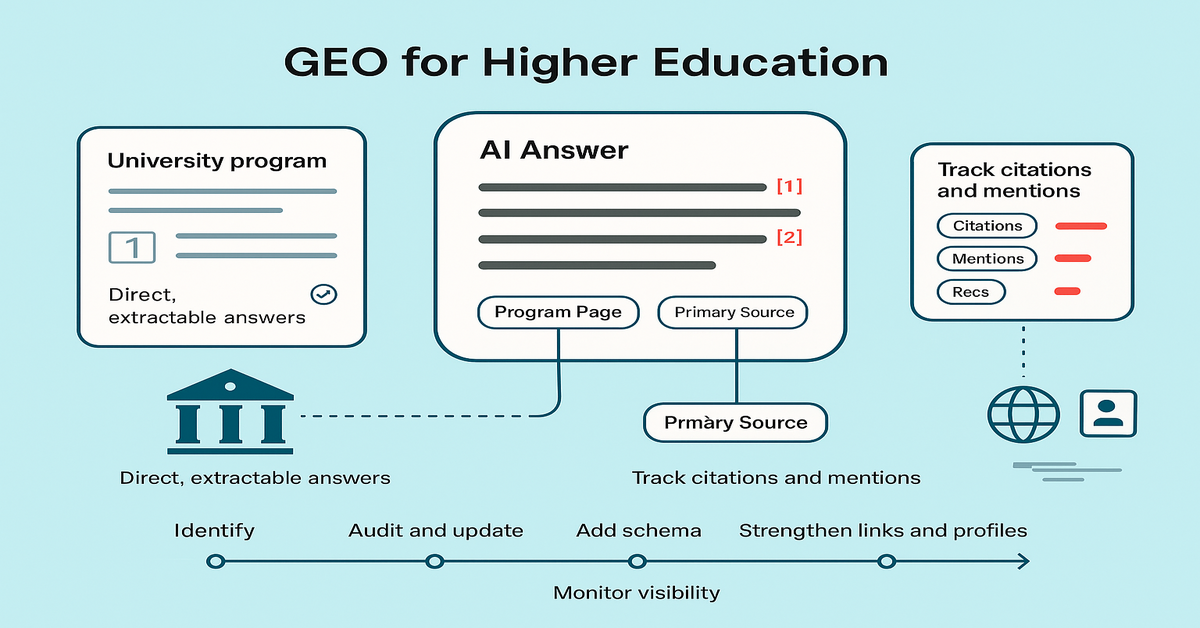
AI powered search now answers questions by synthesizing multiple sources. This creates a zero click world where your content can influence students even if they never visit your site.
Generative engine optimization focuses on being included and cited in those AI answers by publishing clear, extractable, evidence backed information tied to strong entity signals.
For higher education, that means answering questions directly, structuring pages with descriptive headings and FAQs, covering programs in enough detail to be useful, citing primary sources, and keeping details current.
Technical SEO, structured data, and consistent off site references remain essential so AI systems can find, interpret, and trust your content.
Success requires new metrics, mentions, citations, and recommendations across platforms. It also needs a repeatable workflow to test prompts, close content gaps, strengthen authority, and monitor visibility over time.
Read the article here (Author: Will)
Top Takeaways
- Optimize for inclusion in AI answers as well as rankings. Provide direct, extractable answers backed by specific, verifiable data, and reinforce them with strong entity signals and structured data.
- Expand measurement beyond clicks. Track citations, mentions, and recommendations across AI platforms with fixed prompts, and verify how your institution is described.
- Adopt a repeatable GEO workflow. Identify priority programs and questions, audit and update content, strengthen internal links and third party profiles, add accurate schema, and keep information current.
Win AI’s zero click answers with clear facts, schema, and strong entity signals. Track citations not clicks. #HigherEd #SEO #GenAI

Banish Higher Ed Web Nightmares
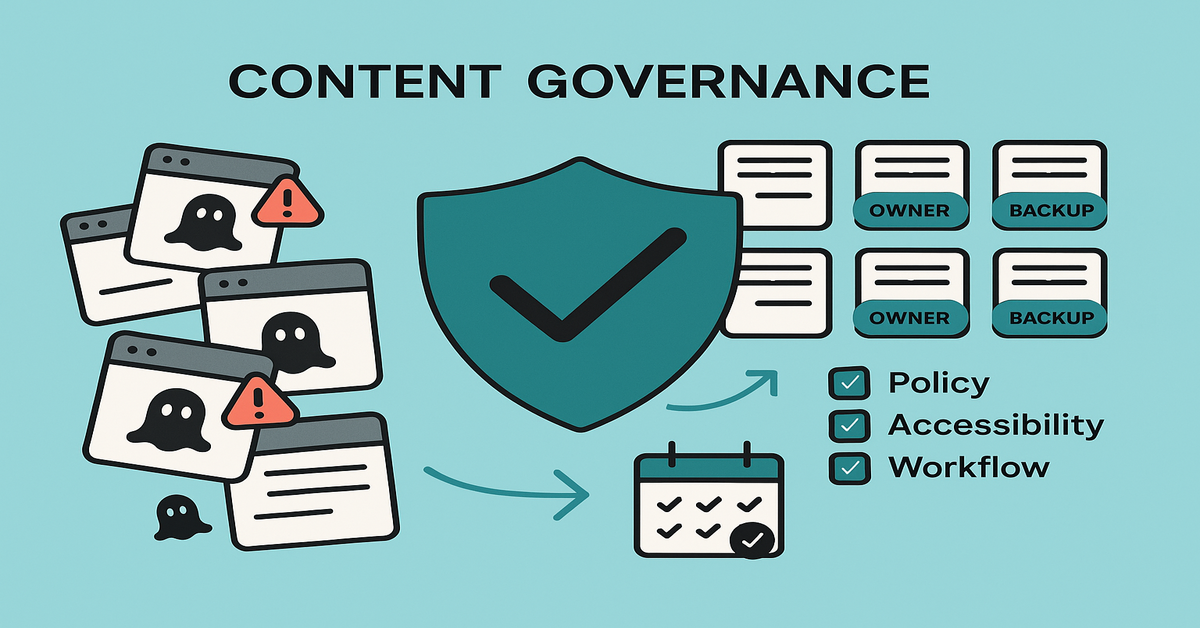
Using spooky anecdotes from higher education web teams, the article shows how the real monster is the absence of content governance. It argues for a formal model that defines roles, page ownership, content policies, accessibility standards, and publishing workflows.
With clear accountability, like assigning an owner and backup to every page, teams can prevent orphaned “ghost” pages and stop small site issues from growing into institutional problems. Strong governance aligns daily operations with long term objectives and keeps content trustworthy, maintainable, and compliant.
Read the article here (Author: hannonhill.com)
Top Takeaways
- Establish a formal governance model that sets roles, responsibilities, content policies, accessibility standards, and publishing workflows.
- Assign an owner and backup to every page, with maintenance schedules, to prevent orphaned content and catch issues early.
- Make governance ongoing. Review, train, and align daily processes with long term goals to reduce risk and scale quality across the institution.
Stop ghost pages with real governance. Assign an owner and backup to every page and make reviews routine. #HigherEd #ContentGovernance
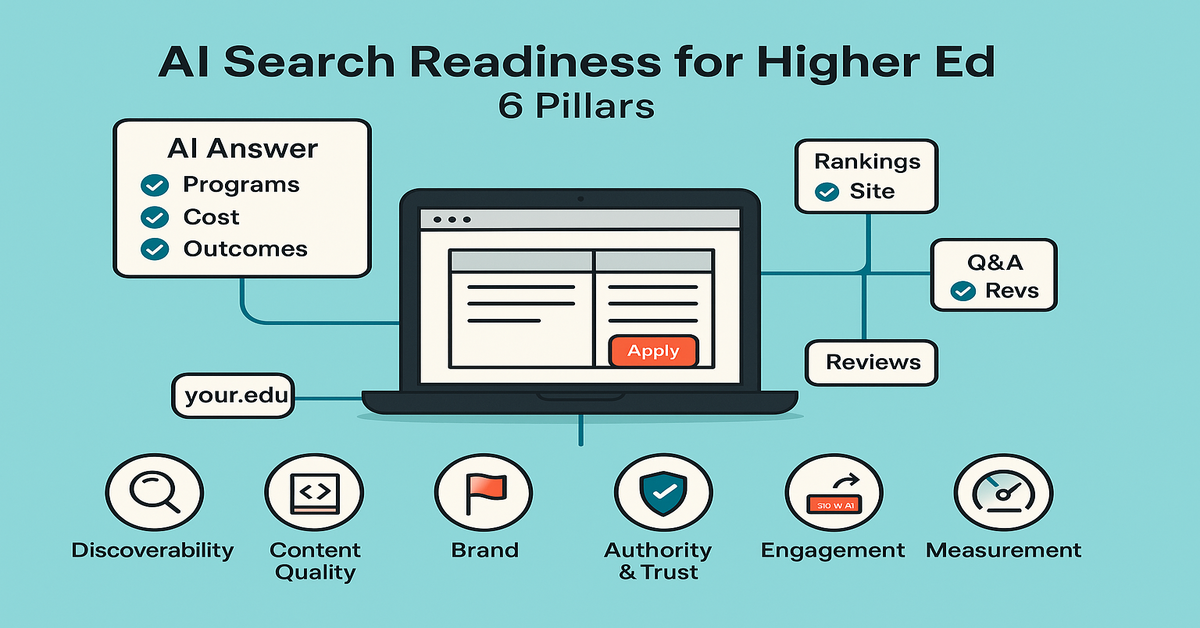
AI Search Readiness for Higher Ed
AI search is transforming how prospective students discover, compare, and consider institutions. Influence is shifting from traditional clicks to AI generated answers.
To stay visible and persuasive, CMOs must ensure AI systems can find, understand, and trust accurate, student centered information across the web, including sources beyond the .edu. A practical readiness assessment spans six areas: discoverability, content quality, brand representation, authority and trust, student engagement, and measurement.
The institutional website remains the authoritative hub, but content must be structured, comparative, and aligned to real student questions. Readiness is an ongoing, cross functional capability that audits third party signals, strengthens differentiators, tracks AI visibility and accuracy, and turns early discovery into confident action.
Read the article here (Author: @EAB)
Top Takeaways
- Treat AI search readiness as a strategic, cross team priority that goes beyond SEO. Ensure your .edu and credible third party sources provide consistent, structured, enrollment critical information aligned to real student questions.
- Audit and improve six pillars. Focus on discoverability, content quality, brand representation, authority and trust, student engagement pathways, and AI specific measurement to understand and close visibility gaps.
- Build an ongoing measurement practice that monitors how AI describes you and competitors, fixes inaccuracies, strengthens differentiators, and tracks prominence, so you can convert early discovery into inquiry and enrollment.
AI search shapes student choice. Win with 6 pillars from discoverability to AI measurement. Make it teamwide #HigherEd #AIsearch
Win With Period and Cohort Reporting
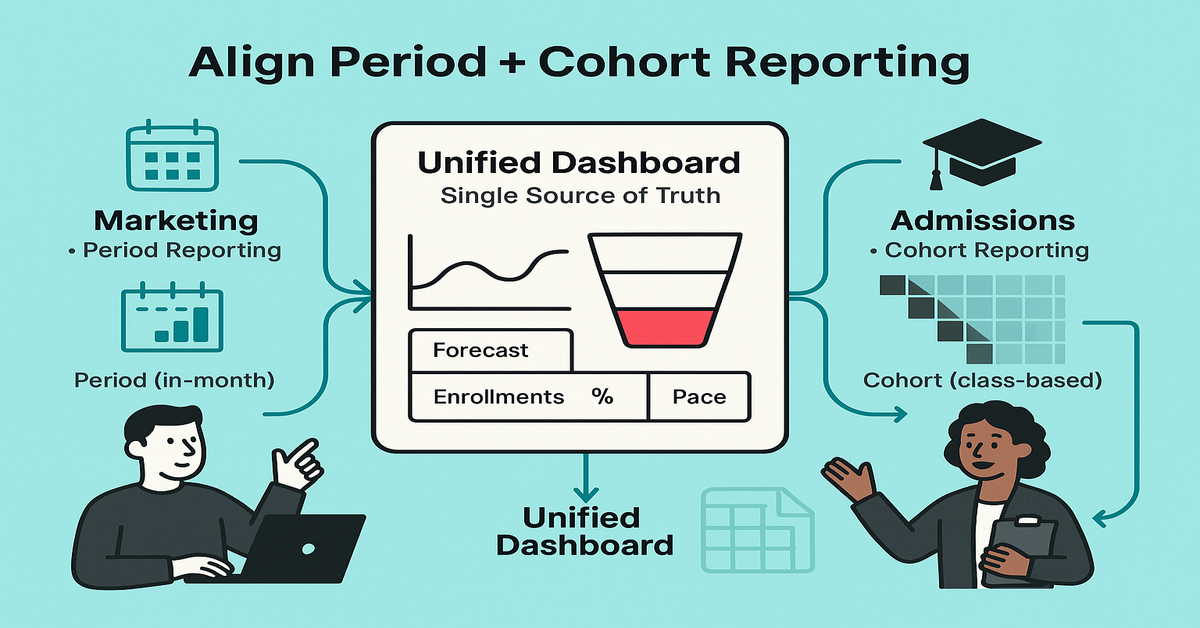
Marketing and admissions often read the same funnel differently because they use different lenses. Period reporting captures in period activity, and cohort reporting follows a class from origin to enrollment.
The episode explains why both views are essential for accurate forecasting and pacing toward enrollment goals, and how unifying them eliminates conflicting narratives. It shows how cohort reporting can replace spreadsheet wrangling, while accounting for seasonality and lead quality. Finally, it makes the case that shared goals, transparent metrics, and a common system like Pennant strengthen trust between teams.
Read the article here (Author: Rustam Irani)
Top Takeaways
- Combine period and cohort reporting to align marketing and admissions, yielding clearer forecasts and better pacing to enrollment targets.
- Adopt cohort reporting to replace manual spreadsheets and reveal seasonality and lead quality effects across the full student journey.
- Set shared goals and use transparent, unified dashboards (e.g., Pennant) to create a single source of truth and build cross team trust.
Unify period and cohort reporting to align teams and forecast enrollment. Build trust with Pennant #HigherEd #Admissions #Enrollment
Unite SEO PR and Content
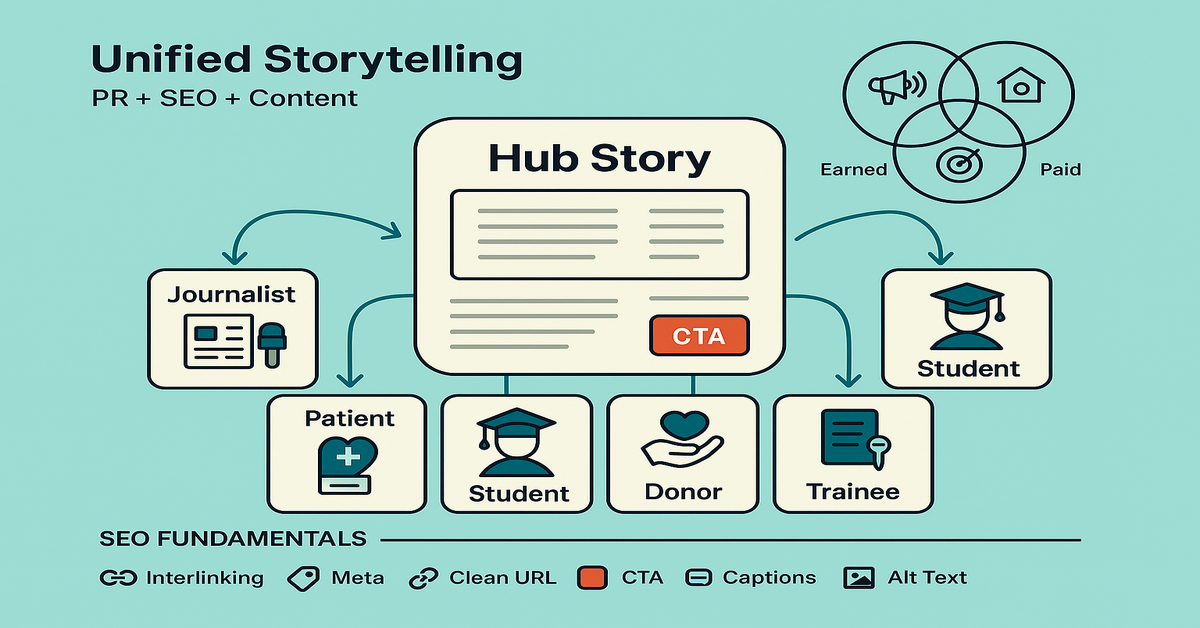
PR and content teams can amplify reach by uniting SEO, PR, and content marketing into one cohesive storytelling strategy. Create a single hub story and tailor it for multiple audiences, journalists, patients, students, donors, and trainees, then distribute it across channels.
Strengthen performance with strategic interlinking and core digital practices like meta descriptions, clean URLs, clear CTAs, descriptive captions, and alt text. Lead with audience needs to surface the most compelling angle. This integrated, earned owned paid approach reduces SME time, scales content production, and increases visibility, media wins, and engagement.
Read the article here (Author: Mariah Tang, Chief Content Marketing Officer)
Top Takeaways
- Build one hub story and adapt it for each audience and platform, including journalists, email subscribers, and owned channels.
- Apply SEO necessities to every asset. Use strategic interlinking, strong meta descriptions, clean URLs, clear CTAs, descriptive captions, and alt text to boost discoverability and depth.
- Combine earned, owned, and paid efforts around a single narrative, led by audience needs, to scale output, reduce SME time, and drive greater reach and engagement.
One hub story for every audience boosts reach and saves SME time. Apply SEO basics and unite earned owned paid. #SEO #ContentMarketing #PR
Reach Gen Z Gen Alpha and Millennials with AI
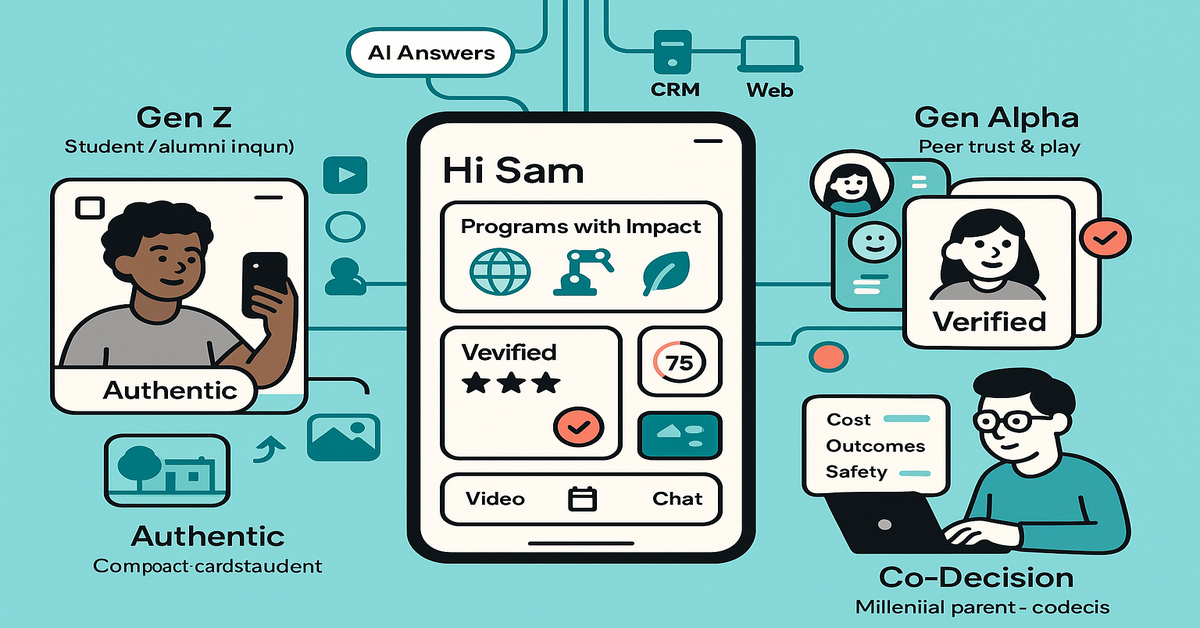
Universities must tailor outreach by generation and by how AI shapes digital behavior. For Gen Z, prioritize authenticity and individualized messaging, using student and alumni influencers and behind the scenes content.
For Gen Alpha, elevate real student voices, verified third party reviews, and playful, data driven personalization powered by connected systems. Use a multichannel mix across Instagram, TikTok, YouTube, websites, and messaging apps, with visual and interactive formats, mobile first design, and live two way engagement.
Showcase programs that deliver real world impact and reflect inclusivity and social responsibility. Expect Millennial parents to be active decision partners and communicate accordingly. Finally, adapt to AI mediated discovery by optimizing for answer and generative engines while building trust across cognitive, cultural, and behavioral differences.
Read the article here (Author: Keystone_edu)
Top Takeaways
- Tailor by generation. Gen Z responds to personalized, influencer led authenticity. Gen Alpha trusts peer voices and verified reviews. Millennial parents will be active participants.
- Adopt a mobile first, multichannel strategy with video, interactive events, and live chats to enable two way engagement and build emotional connection.
- Prepare for AI driven discovery and trust by connecting data systems for personalization, gamifying data collection, and investing in Answer Engine and Generative Engine Optimization.
Reach Gen Z with authentic student voices and 1 to 1 content. Win Gen Alpha with verified reviews. Get AI ready now. #HigherEd #GenZ #AI
Conclusion
The institutions poised to win are building for both humans and machines. Governed content that tells a unified story, structured for discovery, and measured beyond the click.
Align teams on shared metrics, modernize reporting with cohort and period views, and test how AI actually describes you, then fix what it gets wrong. Start small with a priority program, a GEO workflow, and a single hub story amplified across channels. The earlier you adapt to AI mediated discovery, the sooner you convert curiosity into confident enrollment.