AI search is not just changing how students discover programs. It is deciding who makes the cut.
This week’s insights show that citations, structured data, and clear program facts now influence shrinking consideration sets more than traditional rankings alone. Students still verify on university sites, but they increasingly start with AI overviews where trust signals drive clicks. In a zero-click world, visibility and verifiability beat vanity metrics.
Winning that trust means becoming the canonical source that AI and humans both prefer. The throughline across the research is simple. Publish machine-readable, verified information with schema, visible ownership, and consistent entities. Then design pages that are billboard clear on mobile. Pair technical hygiene with topical authority, expert voices, and video to deepen credibility and reach. Measure what matters. AI inclusion, citations, accuracy, and downstream enrollment outcomes.
Beyond search, leaders are navigating real constraints while aiming for bigger impact. Teams are stretched, so focus shifts to activities that move applications and yield, with owned assets compounding value over time. Multichannel, personalized engagement from inquiry through deposit keeps momentum, while outdated content audits protect brand trust and performance. A sobering campus closure this week underscores the stakes, making precision and proof points nonnegotiable. The takeaways below map the moves that matter now.
Key Takeaways
- Be the canonical source with structured, machine-readable program pages that show verified outcomes, costs, requirements, and visible ownership.
- Measure success beyond clicks by tracking AI inclusion, citations, answer accuracy, share of voice, and conversions tied to enrollment outcomes.
- Run recurring content audits to eliminate rot, reduce technical debt, and protect trust, SEO, and future redesigns.
- Blend SEO and AEO. Lead with student questions, concise answers, schema, topical authority, and mobile-first performance.
- Do more with less by investing in owned assets, concentrating on application and yield drivers, augmenting with partners, and using AI for personalization and prediction.
- Engage earlier and across channels with segmented messaging and authentic short video, and shift to multi-touch attribution and quality over list volume.
Controversial Ideas
- Traffic is no longer a primary KPI. Citations and on-SERP visibility can be more valuable than sessions.
- Annual content audits are not enough. Mission-critical pages should have expiration dates and deletion targets.
- First-touch credit and big-name buys are relics. Fewer, better-qualified names can outperform bloated funnels.
- Program pages should function like product spec sheets with downloadable datasets, while brand storytelling plays a supporting role.
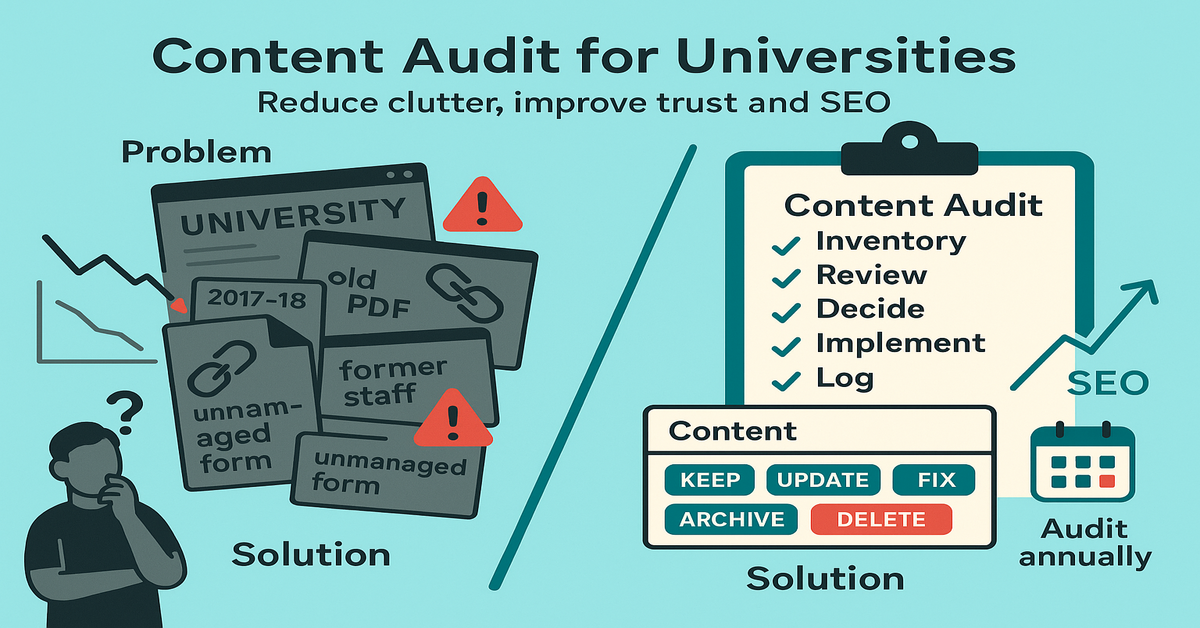
Cut the Cost of Outdated University Content
Outdated pages, PDFs, and microsites on university websites quietly erode trust, mislead students, and drag down user experience, SEO, and brand credibility.
Stale content builds broken links, duplicates, and clutter. That increases maintenance and complicates future audits and redesigns.
The fix is a recurring content audit. Inventory assets, review them systematically, and decide whether to keep, update, archive, delete, or repair.
Build a simple process. Plan, assign an auditor or team, review, evaluate, implement, and log dated decisions.
To spot rot fast, search for old academic years, former staff names, outdated PDFs, and unmanaged pages or forms. At minimum, audit annually to keep information current, reduce technical debt, and protect the institution’s reputation and search performance.
Read the article here (Author: @terminalfour)
Top Takeaways
- Outdated content erodes user trust, hurts SEO, and adds maintenance overhead. It confuses prospective students and leads to broken links and clutter.
- Run a structured content audit at least annually, inventory assets, review and evaluate them, then keep, update, archive, delete, or fix. Record dated decisions to maintain accountability and track progress.
- Find stale material quickly by searching for old academic years, former staff names, outdated PDFs, and unmanaged pages or forms. This accelerates cleanup and reduces future technical debt.
Outdated university pages erode trust and SEO. Run a yearly content audit to keep update archive delete or fix content. #HigherEd #SEO #UX

Win The AI Shortlist
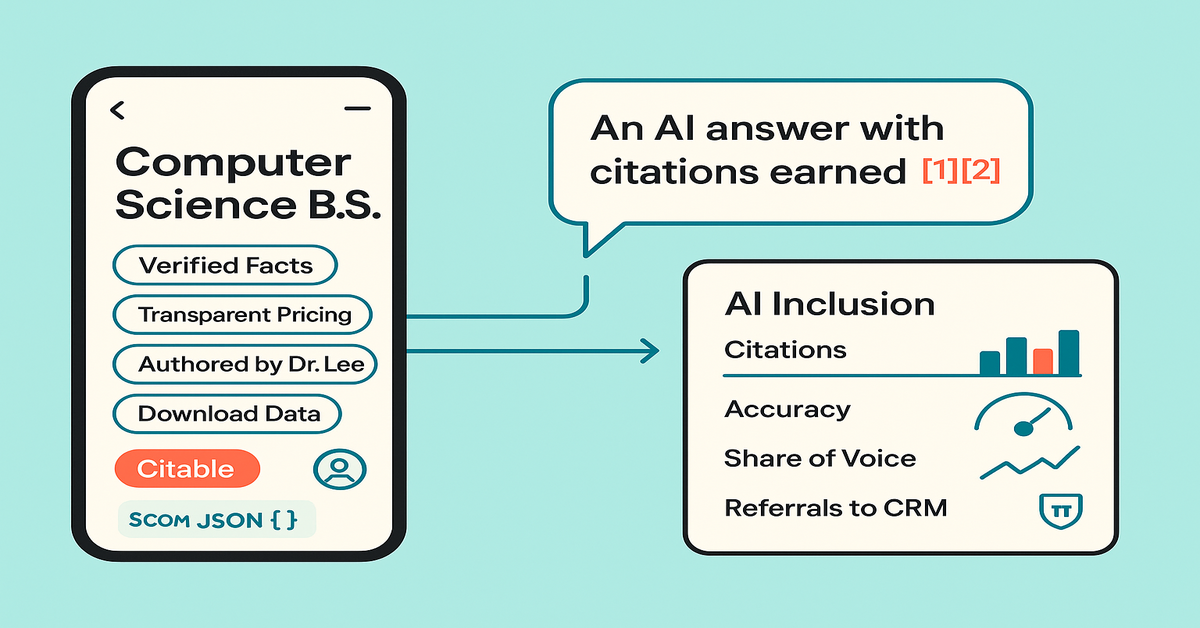
AI search now favors trust, structured data, and consistent entity signals over traditional ranking strength. To earn citations, higher-ed brands should publish canonical, machine-readable program pages with verified facts, visible authorship, org/person schema, and downloadable outcomes and cost data.
Pair intent-led content with corroborating citations, expert voices, and third-party authority signals to build credibility. Design pages for AI parsability and human clarity. Mobile-first, billboard simple, with two to three standout differentiators. Track AI inclusion, citation volume, answer accuracy, share of voice, and referrals alongside SEO and enrollment outcomes.
Read the article here (Author: Will)
Top Takeaways
- Be the canonical source by publishing structured, machine-readable program facts with verified data, visible authorship, consistent naming, and org/person schema. Include transparent pricing, outcomes, FAQs, and downloadable datasets AI can cite.
- Optimize for citations, not just rankings by pairing intent-led content with structured data, corroborating references, expert voices, and third-party authority signals. Require citations and use human-in-the-loop review to reduce hallucinations.
- Design for both AI and humans with mobile-first, billboard-clear pages highlighting two or three differentiators and consistent facts. Measure AI inclusion, citations, answer accuracy, share of voice, and referrals tied to CRM outcomes.
AI search rewards trust. Be canonical with structured data and 2 to 3 differentiators. Track citations and accuracy. #HigherEd #SEO
SEO Essentials for the AI Era
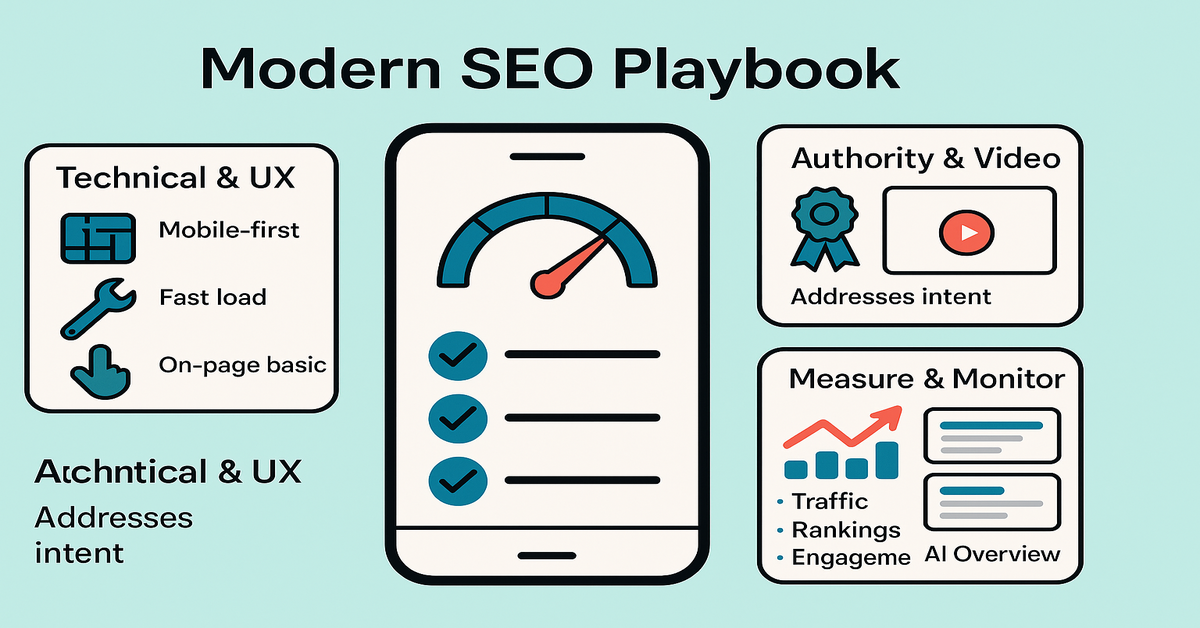
A concise playbook for modern SEO. Solidify fundamentals, fix on-page and technical issues, and design for mobile-first with fast, intuitive UX. Strengthen credibility and broaden reach by demonstrating authority and leveraging video SEO.
Use data to guide continuous optimization in an AI-driven landscape. Track organic traffic, keyword rankings, and engagement. Monitor how content appears in AI Overviews and other answer engines to detect visibility shifts early.
Read the article here (Author: @EAB)
Top Takeaways
- Prioritize technical hygiene and mobile-first performance, ensure responsive design, fast load times, intuitive UX, and strong on-page basics.
- Build authority and expand reach with high-quality content and video SEO that thoroughly addresses user intent.
- Adopt a measurement-first approach, track traffic, rankings, and engagement, and monitor AI Overviews and answer engines to act quickly on visibility changes.
SEO playbook Nail mobile first speed and UX fix basics build authority with video track traffic rankings and AI Overviews #SEO #VideoSEO
Smarter Higher Ed Marketing
A new survey of 121 higher ed marketing leaders conducted in summer 2025 finds teams operating with constrained capacity despite average budgets of $4.15 million, about half devoted to staffing.
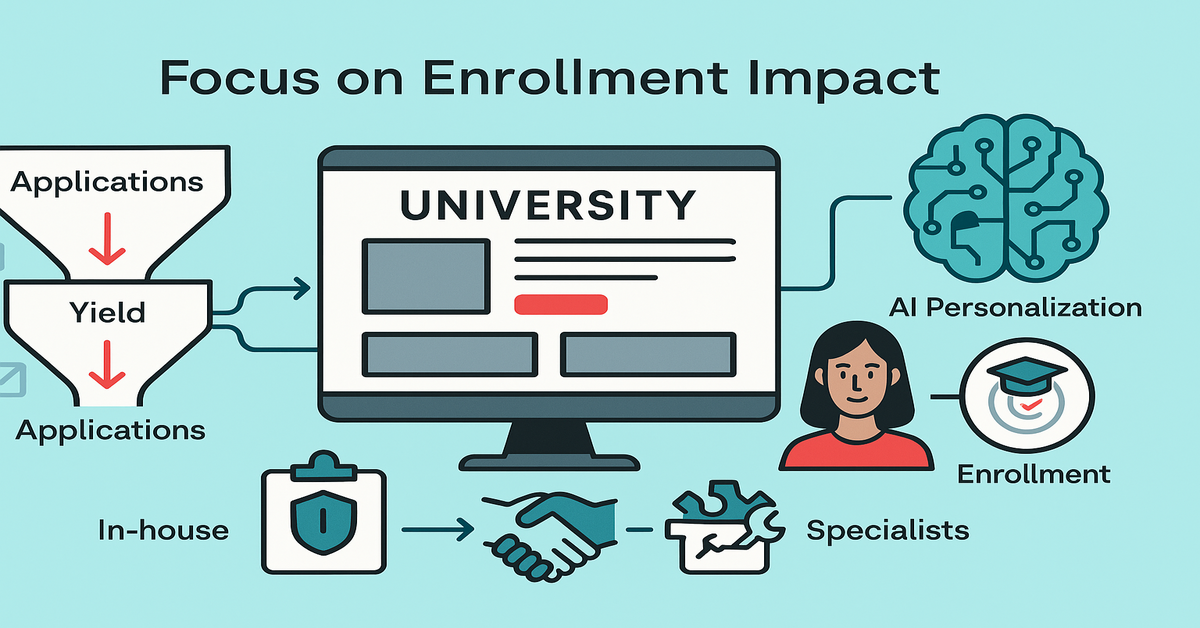
To expand impact without adding headcount, leaders should concentrate effort on activities that drive applications and yield. Invest in owned digital assets like the website that compound value over time. Pair institutional expertise with specialized external support to address capability gaps. Deploy AI to enhance personalization and predictive insight.
Crucially, success should be judged by enrollment outcomes rather than marketing outputs. Align resources and accountability to what matters most.
Read the article here (Author: @EAB)
Top Takeaways
- Prioritize activities directly linked to applications and yield, shift resources away from low-impact tactics.
- Invest in durable owned assets like your website for long-term ROI, and augment in-house teams with specialized external partners to flex capacity.
- Integrate AI to drive personalization and predictive insights, and measure success by enrollment outcomes rather than marketing outputs.
Survey of 121 leaders shows avg $4.15M budgets with half to staffing. Focus on apps and yield build your site use AI. #HigherEd #Enrollment
Make Your EDU the Trusted Source
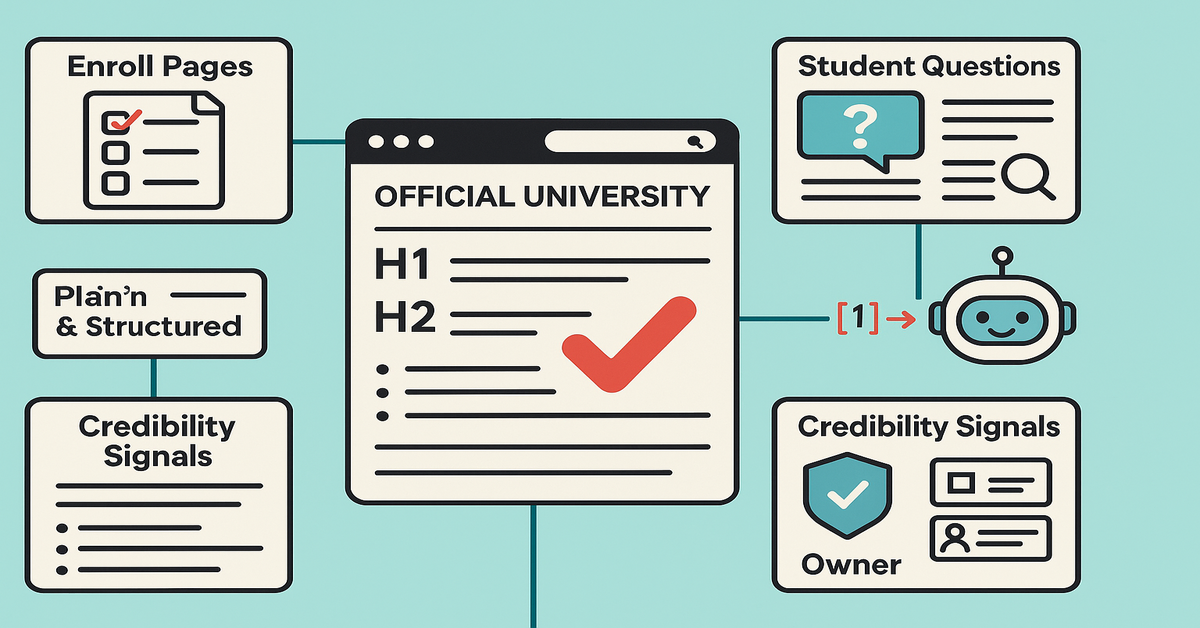
EAB outlines four steps to keep university websites the authoritative resource for students and AI. Prioritize enrollment-critical pages and ensure they are clear, accurate, and complete. Organize content around real student questions. Write in simple, structured language that AI can parse. Add credibility signals like citations, dates, and ownership so students trust and AI can cite.
Following these steps improves usability, search visibility, and the likelihood that AI answers reference official sources.
Read the article here (Author: @EAB)
Top Takeaways
- Prioritize and polish enrollment-critical pages to be clear, accurate, and complete.
- Structure content around how students ask questions to boost findability for humans and AI.
- Use plain language, clear structure, and visible credibility signals so students trust information and AI can cite it correctly.
4 steps to make university sites trusted by students and AI. Polish pages, answer FAQs, use plain language and trust. #HigherEd #SEO
AI Search Visibility Check
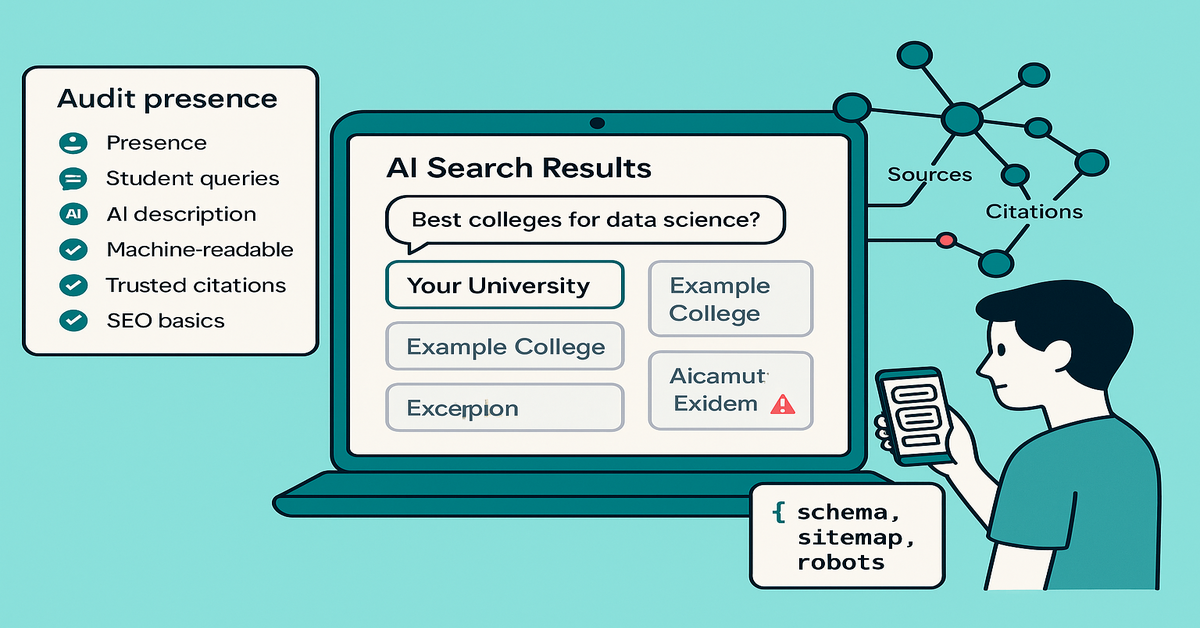
The article outlines six questions for colleges and universities to assess and improve visibility in AI search. Schools should check whether they appear across major AI platforms, if students encounter them or competitors, and what AI says about them.
They must ensure their sites are machine readable, become cited sources that systems trust, and reinforce SEO fundamentals that feed AI models. Together, these checks help institutions surface accurately and prominently when students use AI to research options.
Read the article here (Author: @EAB)
Top Takeaways
- Audit your presence across multiple AI platforms and key student queries, and benchmark visibility against competitors.
- Review how AI describes your institution and fix gaps by publishing clear, up-to-date, structured content on a clean, parsable site.
- Boost authority and AI discoverability with solid SEO, earn reputable citations, implement schema and technical best practices, and maintain high-quality pages.
Make AI find your college with 6 smart checks. Audit platforms, structure content, earn citations, strengthen SEO. #HigherEd #AI #SEO
AI Search Now Shapes Student Choices
AI search is now shaping which programs prospects consider, while university websites remain the top source for verification. Usage is surging, with more students treating AI like a search engine and reading its overviews, yet skepticism is rising.
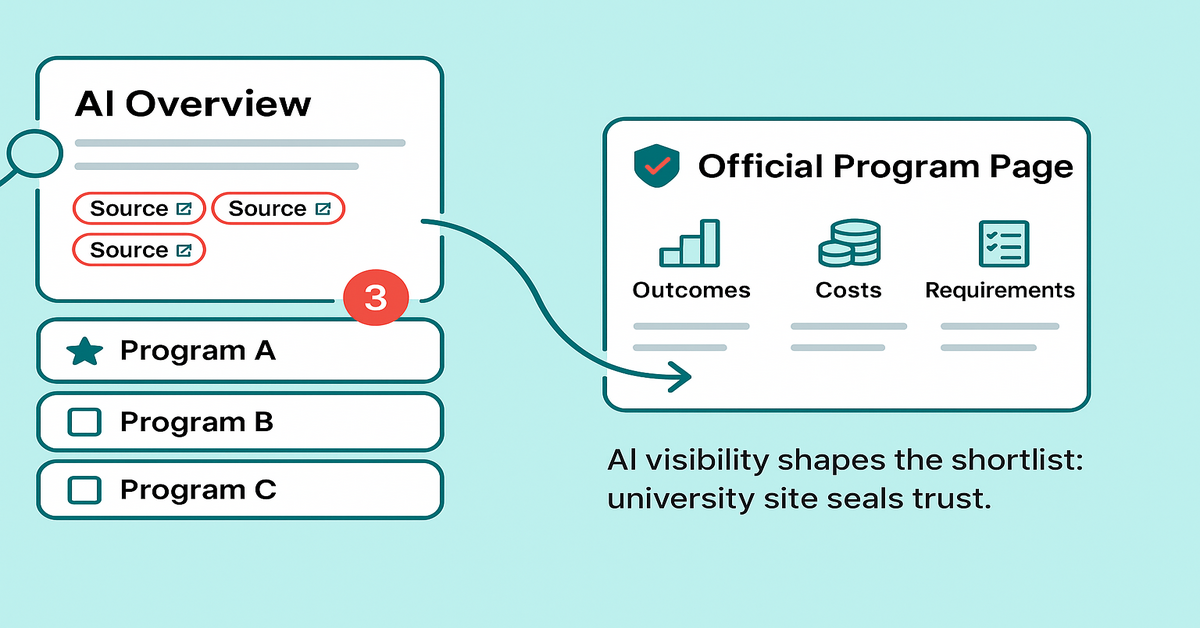
Citations in AI results have become a trust signal that drives more clicks and confidence, even when students double check on institutional sites. As consideration sets shrink to three or fewer programs, visibility inside AI answers can decide who makes the shortlist.
Institutions should optimize for both traditional and AI search. Make content clear, authoritative, structured, and easy to cite. Strengthen program pages that compare outcomes, costs, and requirements to serve as the final trust destination.
Read the article here (Author: UPCEA)
Top Takeaways
- AI results now influence the shortlist as prospects consider three or fewer programs, so earning placement in AI overviews is critical to demand generation.
- Trust is anchored in university websites, but citations in AI answers boost credibility and click throughs, make pages authoritative and keep source data accurate and consistent.
- Optimize for dual discovery by maintaining strong SEO while structuring content for AI consumption with clear program comparisons, outcomes, and costs that are easy to extract and cite.
AI now shapes 3 or fewer program shortlists. Earn citations and build clear pages with outcomes costs and requirements. #HigherEd #AI
Reach Prospective Students Beyond Email
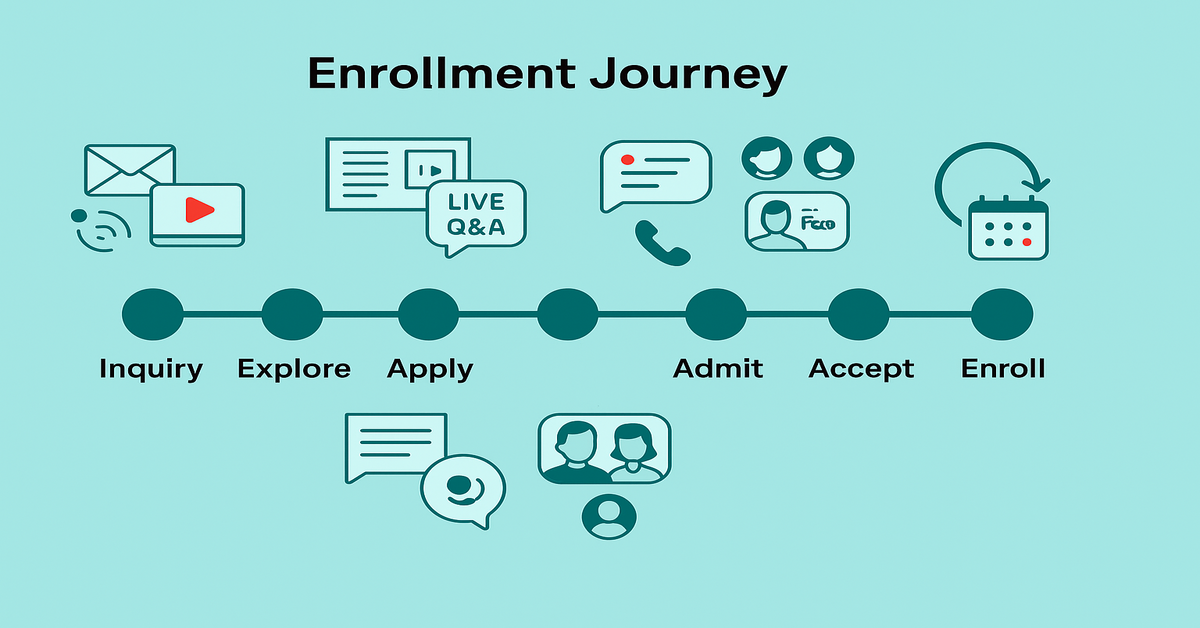
The article outlines a six-part strategy to engage prospective students across the enrollment journey. It recommends a multi-channel mix, email, text, direct mail, phone, paired with messages tailored to each stage from inquiry to acceptance.
Personalization is key, including short, targeted video messages from peers or faculty. Social media, live Q&As, and campus-life content expand touchpoints, while texts and WhatsApp meet students on preferred platforms.
Post-acceptance, sustained engagement through ambassador stories, retargeting to deposit deadlines, peer connections, and faculty outreach keeps momentum toward enrollment.
Read the article here (Author: Lisa Starkey-Wood)
Top Takeaways
- Adopt a multi-channel plan and match content to stage, email for updates, texts for nudges and deadlines, direct mail for families, and calls for milestone moments.
- Personalize at scale with segmented messaging and short, authentic videos from current students or faculty who share traits or interests with recipients.
- Maintain post-acceptance momentum using ambassador testimonials, retargeting around deposit deadlines, peer connections, and faculty touchpoints to drive yield.
Boost yield with a 6 part plan across email text mail calls plus personalized videos and post acceptance nudges. #HigherEd #Enrollment
Rethink Student Search Assumptions
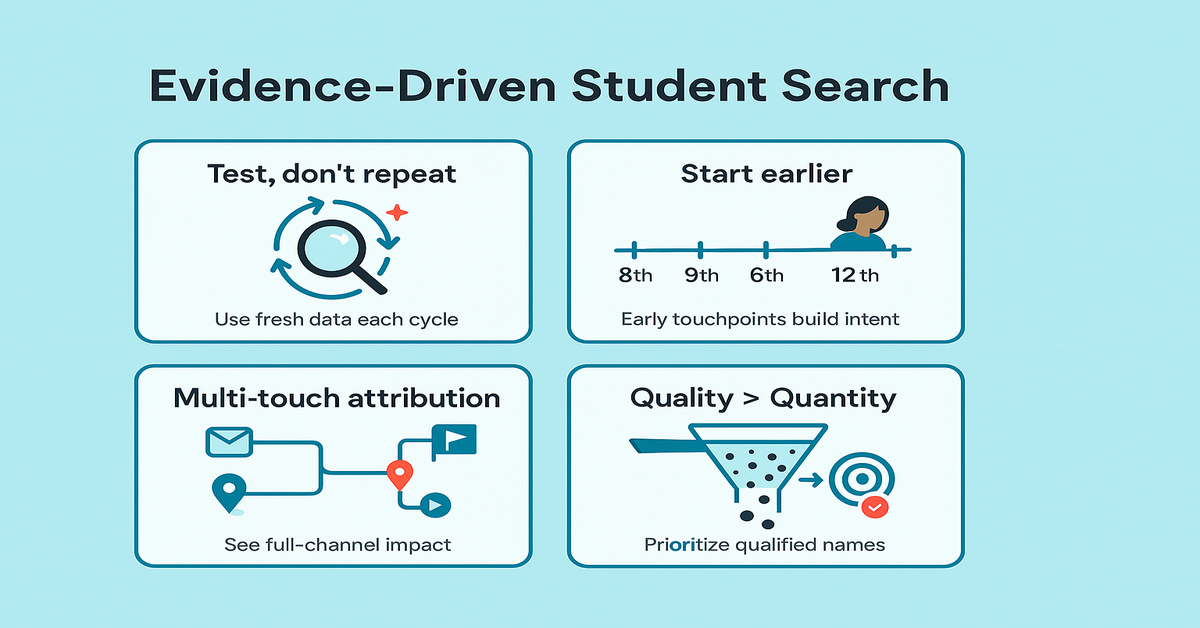
Many enrollment teams rely on assumptions that no longer hold. The article urges leaders to pressure-test four beliefs, that last cycle’s tactics will repeat their success, that meaningful search begins in junior or senior year, that the first source to produce a name deserves enrollment credit, and that more names automatically create more opportunity.
It recommends using current data to refine strategy each cycle. Engage students earlier to shape intent. Adopt multi-touch attribution to reveal true channel impact. Prioritize qualified prospects over volume. The goal is a more precise, outcome-driven student search plan built on evidence, not inertia.
Read the article here (Author: @EAB)
Top Takeaways
- Treat past performance as a hypothesis to validate each cycle. Use fresh data to test, iterate, and optimize your mix.
- Engage earlier than junior year. Early touchpoints build awareness and intent that improve later conversion.
- Move beyond first-source attribution and list volume. Adopt multi-touch measurement and prioritize qualified names over quantity.
Test past wins each cycle. Start before junior year and use multi touch attribution. Quality names beat volume #Enrollment #Admissions
Zero click search reshapes SEO
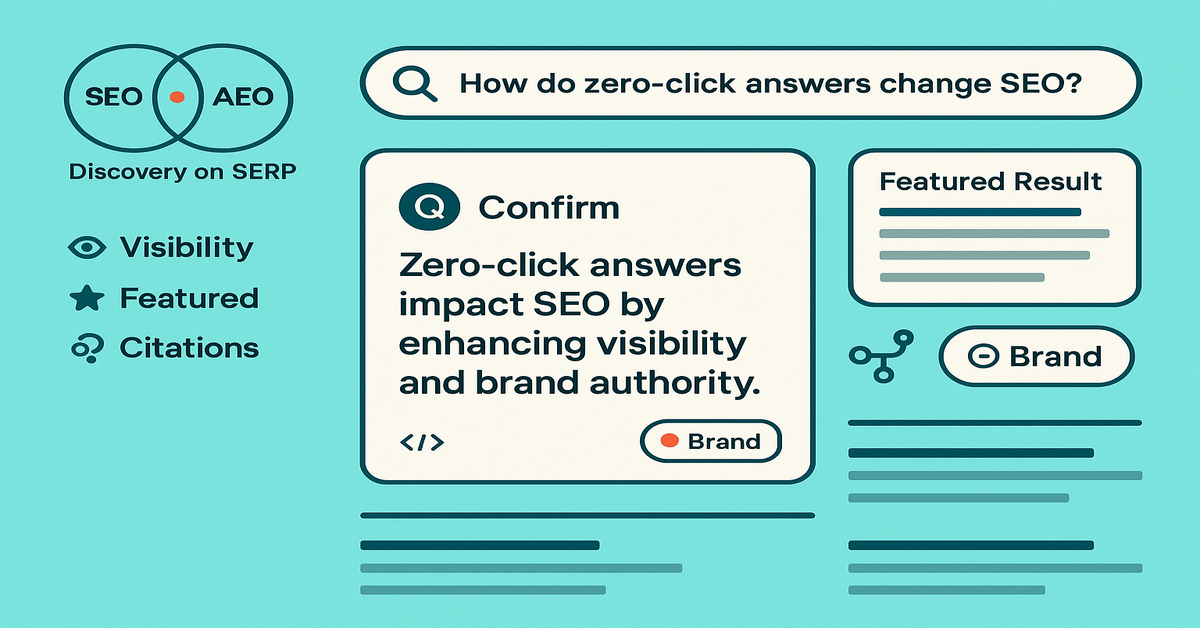
Zero-click results give users answers on the results page, reducing site visits and shifting SEO goals beyond traffic. Success now includes visibility, citations, and brand presence within AI-driven answers and rich results.
Traditional ranking still matters, but answer engine optimization emphasizes question-led content, concise responses, structured data, and topical authority to be easily extracted and cited. Marketers combine SEO and AEO because search demand remains. Discovery increasingly happens on the SERP.
Read the article here (Author: Stu Eddins, Chief Digital Strategy Officer)
Top Takeaways
- Optimize for answer engines by structuring around user questions, leading with concise answers, adding schema, and building topical authority so systems can extract and cite your content.
- Measure success beyond clicks by tracking SERP visibility, featured placements, and citations in AI answers to capture brand value in zero-click experiences.
- Treat AEO as a complement to classic SEO, continuing traffic-focused ranking efforts while adapting content for zero-click discovery.
Zero click is here Optimize for answer engines with concise answers schema and topical authority Track SERP and AI citations #SEO #AEO
Sterling College Closes in Vermont
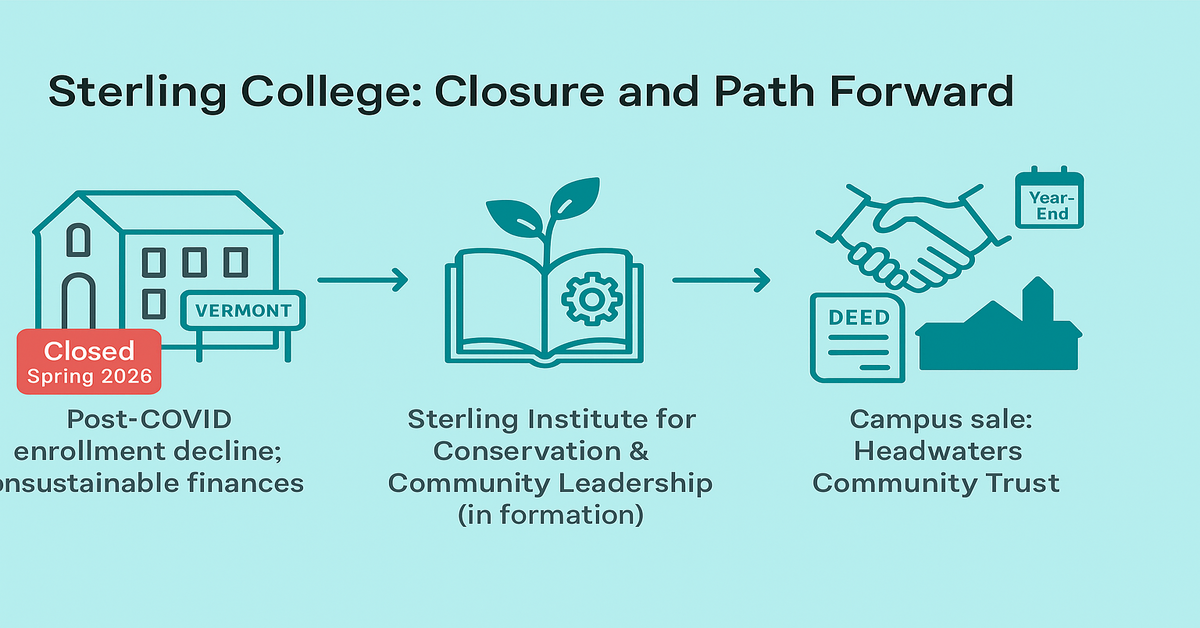
Sterling College, a small private nonprofit in Craftsbury, Vermont, founded in 1958 and known for hands-on ecological education, closed after the spring 2026 term.
Post-COVID enrollment declines and financial strain left the 57-student institution unable to sustain operations, even after narrowing its academic focus. Without a partner or new funding, the economics no longer worked. That led to a closure announcement in November 2025.
A successor effort, tentatively named the Sterling Institute for Conservation and Community Leadership, aims to continue environmental education and workforce development. In mid-September, Headwaters Community Trust signed a sale agreement for the campus and began due diligence, expecting to finalize the property transfer by year-end.
Read the article here (Author: Ben Unglesbee)
Top Takeaways
- Sterling College closed after spring 2026 due to post-COVID enrollment declines and unsustainable finances, despite attempts to streamline academics.
- A new entity, the Sterling Institute for Conservation and Community Leadership, is being formed to continue environmental education and workforce development.
- Headwaters Community Trust signed a sale agreement for the campus and expects to complete the purchase by the end of the year.
Sterling College closes spring 2026 with 57 students. New Sterling Institute is planned. Headwaters to buy by year end. #HigherEd #Vermont
AI Search Optimization for Higher Ed
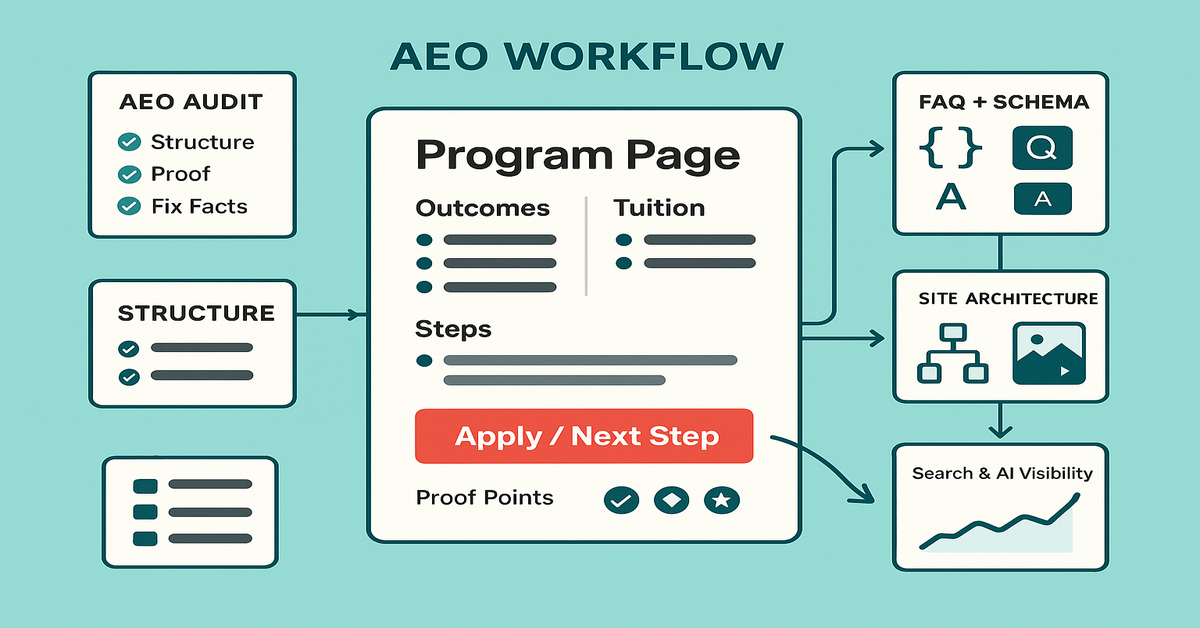
Carnegie advises higher education marketers to make websites clear, structured, and credible so AI answer engines can understand and cite them. Key steps include auditing content for context and proof points, adding schema and FAQs, building detailed program pages with outcomes and costs, and improving architecture, internal links, and multimedia metadata.
Institutions should run answer audits on high-intent student questions. Fix inaccuracies on priority pages, and standardize page templates that map to student decision needs. Shift from fragmented posts to thorough, expert-driven guides that address related subtopics.
Track branded search and AI visibility across Search Console and answer engines. Throughout, design for conversion with obvious next steps and fast, complete answers.
Read the article here (Author: Rebecca Hofstetter)
Top Takeaways
- Prioritize structure and proof. Use schema, FAQs, standardized program pages, and institution-specific proof points so AI engines can parse and quote you accurately.
- Run a repeatable AEO workflow. Audit AI answers to key student questions, correct facts on priority pages, and template pages around predictable decision info like outcomes, tuition, and steps.
- Optimize for outcomes, not just presence. Track branded search and AI visibility, and design pages for conversion with clear next actions and thorough, expert-driven guides.
Win AI answers with structured .edu pages. Use schema FAQs proof points. Show outcomes tuition steps. Track conversion #HigherEd #SEO #AEO
Conclusion
In an era where AI shapes discovery and students demand proof, trust becomes the strategy. Institutions that publish structured, verified, and citation-ready content, then measure impact by enrollment will own the shortlist.
Start this week by auditing your top program pages, adding schema and clear ownership, and benchmarking AI visibility against competitors. Focus your team on what compounds value and moves yield, and let data, not habit, guide the next iteration.