Search just changed the campus tour. Prospective students now start with conversational AI, where authority and context beat keywords and blue links. PR, structured data, and intent-rich content determine which programs earn citations in ChatGPT, Claude, and AI Overviews. At the same time, UX speed and accessibility move from nice to have to mandated baselines. Core Web Vitals and WCAG 2.1 AA set the rules for 2026.
Enrollment teams are shifting from campaigns to connected journeys. AI-powered personalization, CRM automation, and multichannel storytelling meet students on their terms across search, short-form video, SMS, email, and in-person experiences. High-impact SEM reframes enrollment as an enterprise model that aligns mission, pricing, aid, recruitment, and retention under one governance roof. In graduate business, demand is tilting toward specialized, flexible, AI-aligned programs, which raises the stakes for proof of ROI and visa clarity.
Execution is where leaders win. This week’s playbooks stress disciplined audits, AI visibility, redirects and logs, Core Web Vitals, and accessibility. They also highlight zero-based redesigns, topic clusters, and earned-media amplification. They underscore partner fit and transparency when choosing agencies, and the need to measure what actually matters in a zero-click world. With that context, let’s unpack the most important moves institutions can make right now.
Key Takeaways
- Treat AI as the new front door. Optimize for citations, not just rankings. Pair intent-led content with structured data and sustained earned media.
- Make performance and accessibility non negotiable. Hit LCP, CLS, and INP targets on mobile. Build a documented WCAG 2.1 AA roadmap ahead of the 2026 deadline.
- Personalize the full journey with CRM-driven segmentation, Answer Engine Optimization, and transparent outcomes and aid. Combine digital touchpoints with high-impact visits and events.
- Harden technical SEO with rigorous redirect testing, server-side experimentation, schema validation, and log analysis. Prioritize HTTPS first, single hop canonicals, and weekly monitoring.
- Run SEM as an enterprise strategy that unifies pricing, recruitment, and retention. Tie programs to labor-market demand. Report ROI on shared dashboards.
- Reposition graduate business pipelines toward specialized, flexible, AI-infused offerings. Protect international yield and diversify into domestic working-professional segments.
Controversial Ideas
- PR is the new SEO. Shift budget from link building and content volume to earned media and executive branding. AI answers cite third parties far more than brand sites.
- In a zero click search era, traffic is a vanity metric. AI answer share, citations, and on-page pixel position should outrank sessions in your KPIs.
- Stop incremental redesigns and start over. Zero based rebuilds beat years of tweaks when Core Web Vitals and conversion are on the line.
- Quit fighting yesterday’s MBA arms race. Double down on specialized master’s and working professionals where ROI and flexibility win.
AI Visibility Drives Enrollment
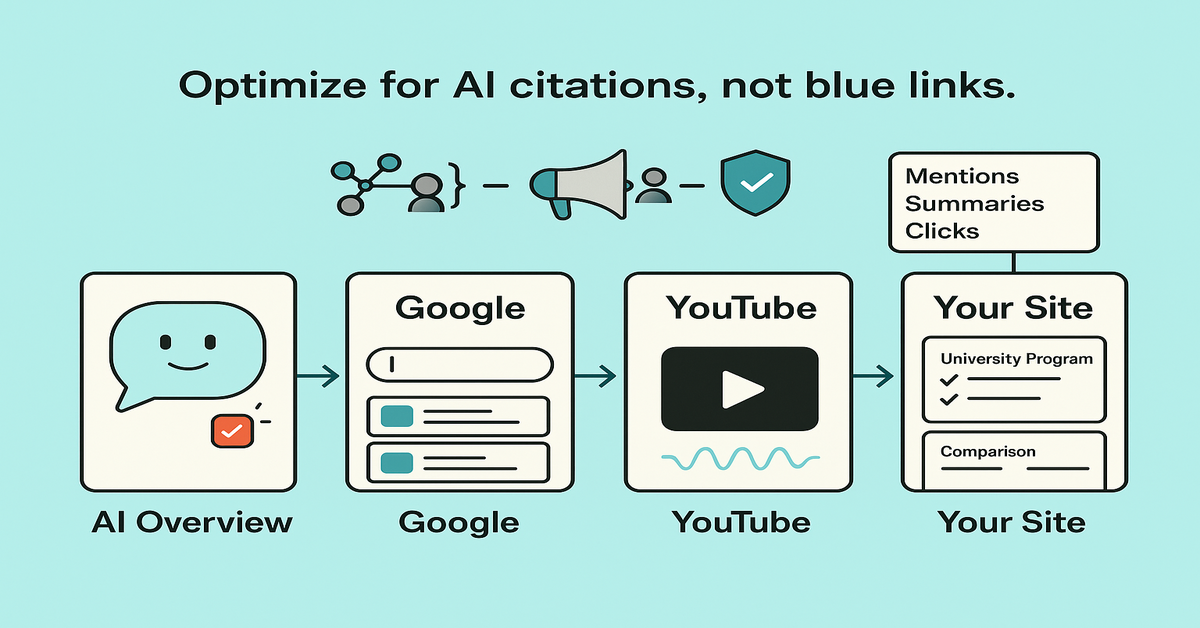
Prospective students increasingly start their searches with conversational AI. AI visibility is now as essential as traditional SEO. Institutions that earn citations in tools like ChatGPT, Claude, and Google’s AI Overviews see better qualified traffic and higher conversion.
Winning requires intent-driven content ecosystems, rigorous structured data, and authority signals from PR, alumni, and faculty so AI can interpret and recommend programs. Measure success by mentions and summaries, not just clicks.
Pair AI-aware SEO with a layered journey strategy. AI provides the overview, Google expands options, YouTube builds affinity, and your site verifies details. Practical steps include auditing AI visibility, restructuring program pages around outcomes and comparisons, segmenting audiences, and treating AI as a core KPI. Early adopters are already boosting lead volume and applicant quality.
Read the article here (Author: Will)
Top Takeaways
- Treat AI as the front door and optimize for citations, not blue links. Use schema, clear program details, and authoritative sources so AI systems can interpret and recommend you.
- Build intent-driven content ecosystems that blend facts, context, and credibility to answer complex queries and improve qualified lead quality.
- Operationalize the playbook. Run AI visibility audits, refresh pages around outcomes and comparisons, activate PR with alumni and faculty voices, and align SEO with multichannel conversion tactics.
AI is the new front door. Earn citations in ChatGPT Claude and AI Overviews to lift qualified leads and conversions. #HigherEd #AI #SEO

2026 Website Optimization Playbook
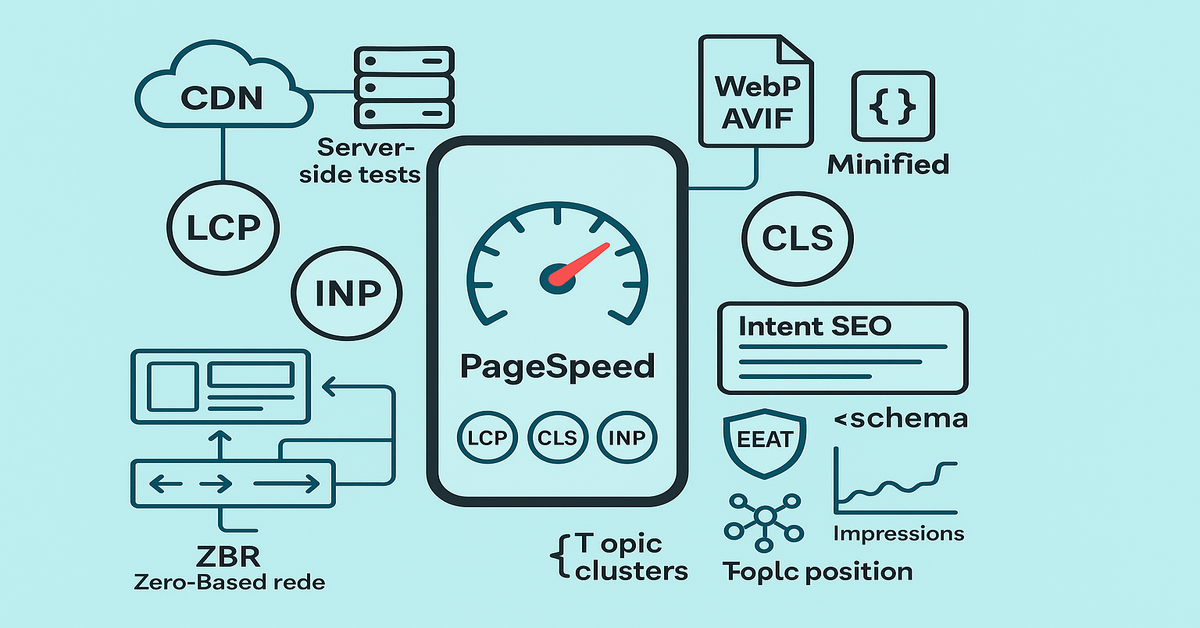
As 2026 approaches, winning websites center on user experience measured by Core Web Vitals (LCP, CLS, and INP) paired with a mobile-first mindset. Speed is a ranking factor. Use optimized hosting and CDNs, modern image formats, and minified code. Review PageSpeed Insights regularly.
Favor server-side testing to prevent client-side latency. Rebuild bloated sites with zero based redesigns that streamline navigation and user flows. SEO shifts from keywords to intent. Publish EEAT-rich content, add structured data, organize topic clusters, stay fresh, and show up across platforms. Track impressions and on-page pixel position, not just traffic. Start with a vitals audit, mobile upgrades, a ZBR pilot, and content refreshes.
Read the article here (Author: hannonhill.com)
Top Takeaways
- Make UX and speed non negotiable. Optimize for LCP, CLS, and INP with mobile-first design, responsive images, compressed assets, CDNs, and regular PageSpeed checks. Use server-side experimentation to protect performance.
- Reset legacy websites with zero based redesigns to eliminate design debt and streamline navigation, content hierarchy, and user flows for higher conversions.
- Shift SEO to intent and EEAT with structured data, fresh topic clusters, and multi-platform visibility. Measure impressions and pixel position, and avoid link buying and keyword stuffing.
Win 2026 on UX and speed. Nail LCP CLS INP with CDNs mobile first images and server tests. Shift to EEAT intent. #SEO #CoreWebVitals #UX
PR Is the New SEO
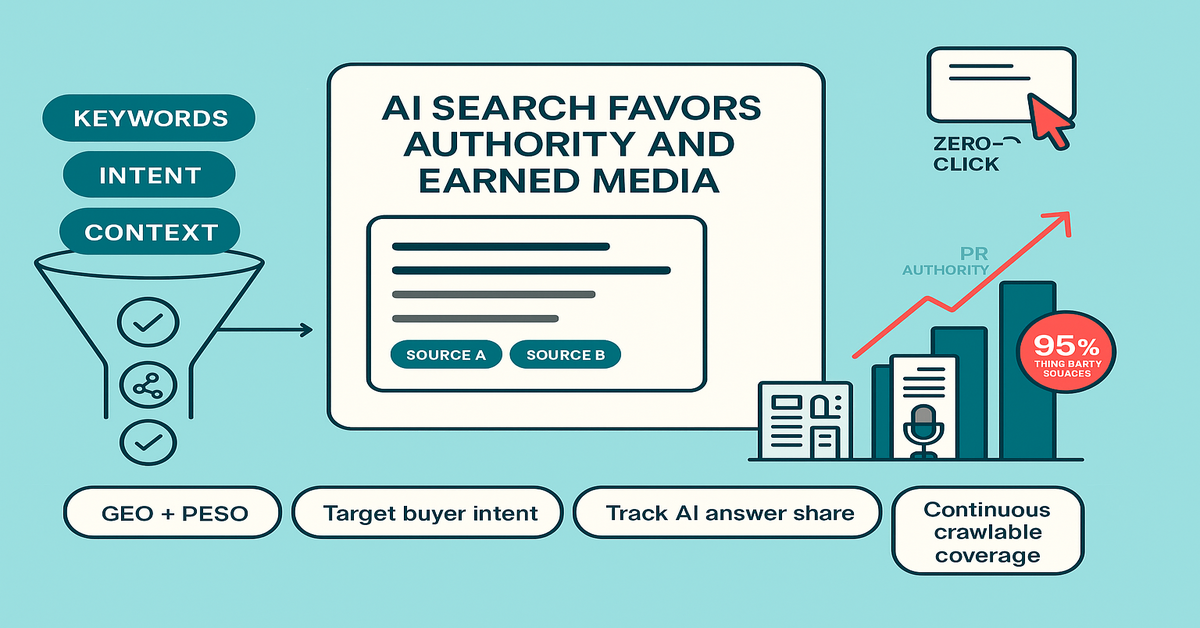
AI powered search shifts discovery from keywords to context, intent, and authority. It produces zero click answers that cite mostly third party sources. As 95 percent of links in AI outputs come from earned media, PR now outperforms traditional SEO in shaping what models recommend.
Building authority through high domain publications, thought leadership, and consistent, crawlable coverage raises brand citations and AI visibility. Teams should adopt GEO practices alongside PESO, target buyer intent queries, track AI answer share, and amplify earned placements. With models training on months old data and e commerce clicks declining, the brands that invest in ongoing PR and personal branding will dominate AI summaries and recommendations while SEO only tactics fade.
Read the article here (Author: Jess Antle)
Top Takeaways
- AI search favors authority and earned media over keywords, with 95 percent of cited links coming from third party sources. Consistent PR in high authority outlets lifts brand citations and visibility in AI answers.
- The zero click shift reduces site traffic. Prioritize trusted PR signals like podcasts, op eds, and analyst reviews. Use GEO to target buyer intent queries and measure AI answer share.
- Future proof your brand by maintaining continuous, crawlable coverage and avoiding paywalls. Build executive and personal brands. Integrate PESO with GEO to influence models trained on data that is 6 to 12 months old.
AI search cites 95 percent earned media. PR with GEO and PESO beats old SEO. Build authority to win zero click answers. #PR #AIsearch #SEO
Data Driven Enrollment Growth
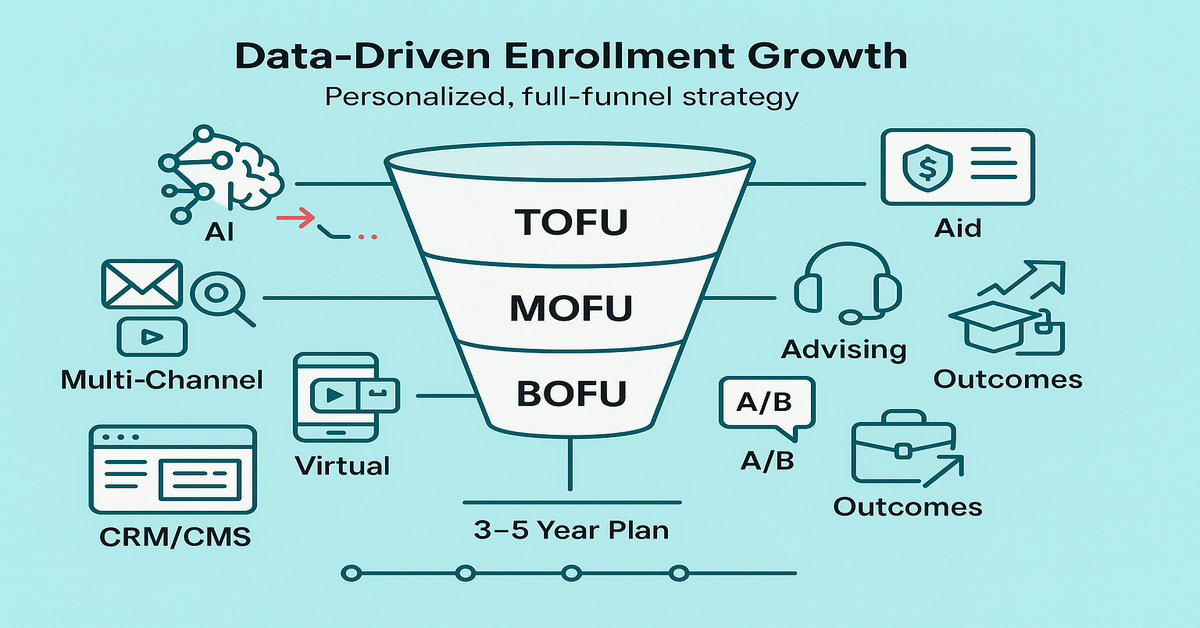
Amid tighter competition and higher expectations, universities can grow enrollment by adopting data-driven, student-centric strategies across the funnel. Use AI, analytics, and behavior data to personalize communications, scholarships, and interventions that improve conversion and retention.
Redesign TOFU, MOFU, and BOFU with integrated CRM and CMS workflows, virtual tours and webinars, mobile-first experiences, transparent financial aid, and dedicated advising. Prioritize multi channel digital marketing and authentic community building. Align programs to market demand and highlight affordability and outcomes, especially for nontraditional learners. Plan over 3 to 5 years, segment audiences, collaborate across departments, and iterate via measurement and A/B testing to scale what works.
Read the article here (Author: Manno Notermans)
Top Takeaways
- Personalize the full student journey with AI and predictive analytics. Deliver targeted communications, scholarships, and timely interventions that raise conversion, retention, and graduation.
- Build a disciplined full-funnel strategy using integrated CRM and CMS, virtual experiences, transparent financial aid, and dedicated advising to move prospects to matriculation.
- Adopt multi channel, consumer grade marketing. Address affordability and adult learner needs. Execute 3 to 5 year, cross-functional plans measured by A/B tests and engagement metrics.
AI powered personalization and full funnel TOFU MOFU BOFU boost enrollment. 3 to 5 year plans lift conversion and retention. #HigherEd #AI
Beat the 2026 Accessibility Deadline
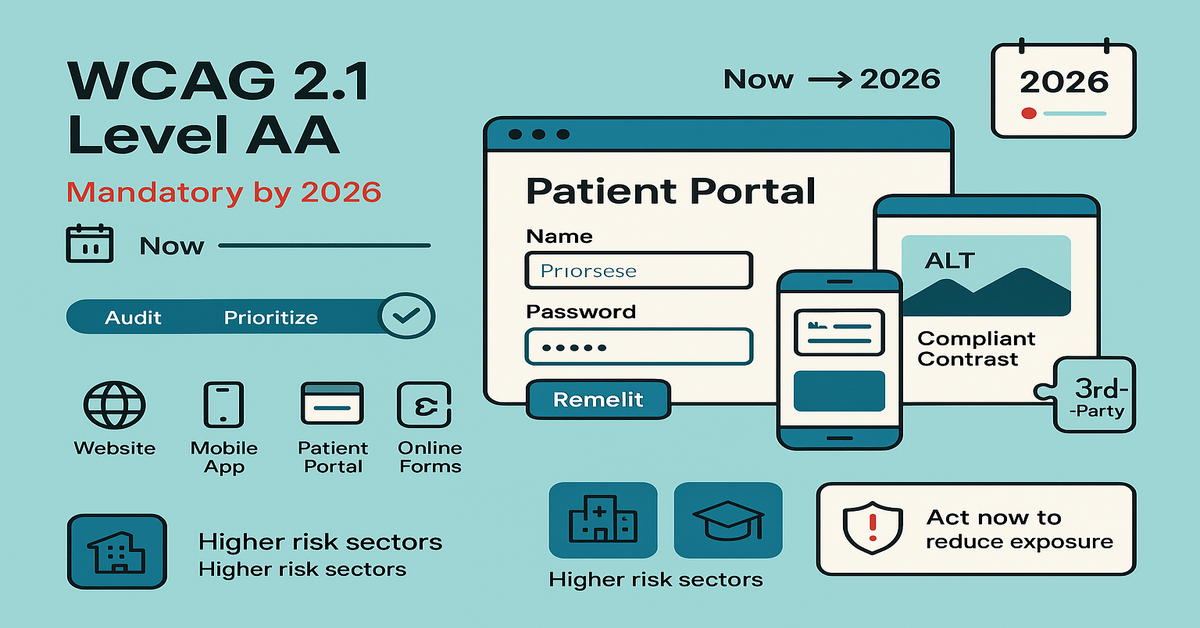
New federal rules finalized in 2024 make WCAG 2.1 Level AA a firm, enforceable requirement for all public-facing web content and mobile apps by 2026. The scope covers websites, patient portals, online forms, and third-party integrations. Urgency is heightened for healthcare and higher education.
Lawsuits are rising, and regulators expect demonstrable progress on a fixed timeline. The defensible path is to act now. Audit your digital footprint, prioritize barriers, and execute a documented remediation plan. Good faith efforts can mitigate legal exposure. Neglect will not.
Read the article here (Author: Christopher Lott)
Top Takeaways
- WCAG 2.1 Level AA is now mandated with hard 2026 deadlines, best practices have become enforceable standards.
- Compliance covers websites, mobile apps, patient portals, online forms, and third-party tools, with acute risk for healthcare and higher ed.
- Start immediately. Run audits, prioritize fixes, and execute a documented roadmap. Demonstrable good faith remediation is defensible, while inaction invites lawsuits.
WCAG 2.1 AA is mandatory by 2026 for websites and apps. Audit now and document fixes to cut lawsuit risk. #Accessibility #WCAG #Compliance
College Marketing That Converts
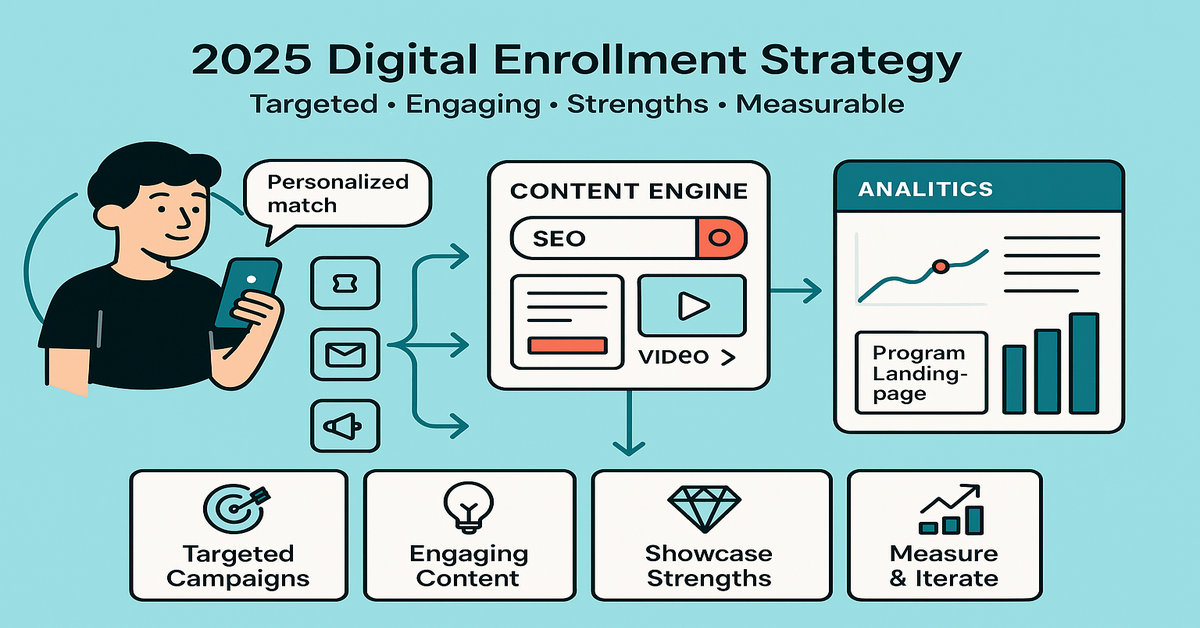
To stay competitive in 2026, colleges must pair a clear brand message with data-driven outreach that speaks to prospective students’ academic goals. The article recommends leveraging social media, email, and targeted ads alongside robust content marketing, including blogs, videos, and program-specific landing pages, optimized for SEO.
Retargeting re engages visitors, while personalized messaging highlights programs, scholarships, and research opportunities that match student interests. A focused digital strategy centers on four pillars, targeted campaigns, engaging content, showcasing institutional strengths, and measurable results. By aligning content with evolving education and job-market trends and nurturing leads through each decision stage, colleges can build awareness, deepen trust, and convert interest into enrollments.
Read the article here (Author: Manno Notermans)
Top Takeaways
- Personalize outreach with data to spotlight programs, scholarships, and research that match student interests. Keep messaging clear and student centric.
- Build an always on content engine with SEO optimized blogs, videos, and program landing pages. Amplify with social, email, and retargeting to nurture prospects.
- Run a disciplined digital strategy focused on targeted campaigns, showcasing strengths, and measurable results. Iterate based on performance and market trends.
Convert 2025 interest into enrollments with data driven personalization SEO content social email and retargeting #HigherEd #EdMarketing
Authentic Personalization Drives Enrollment
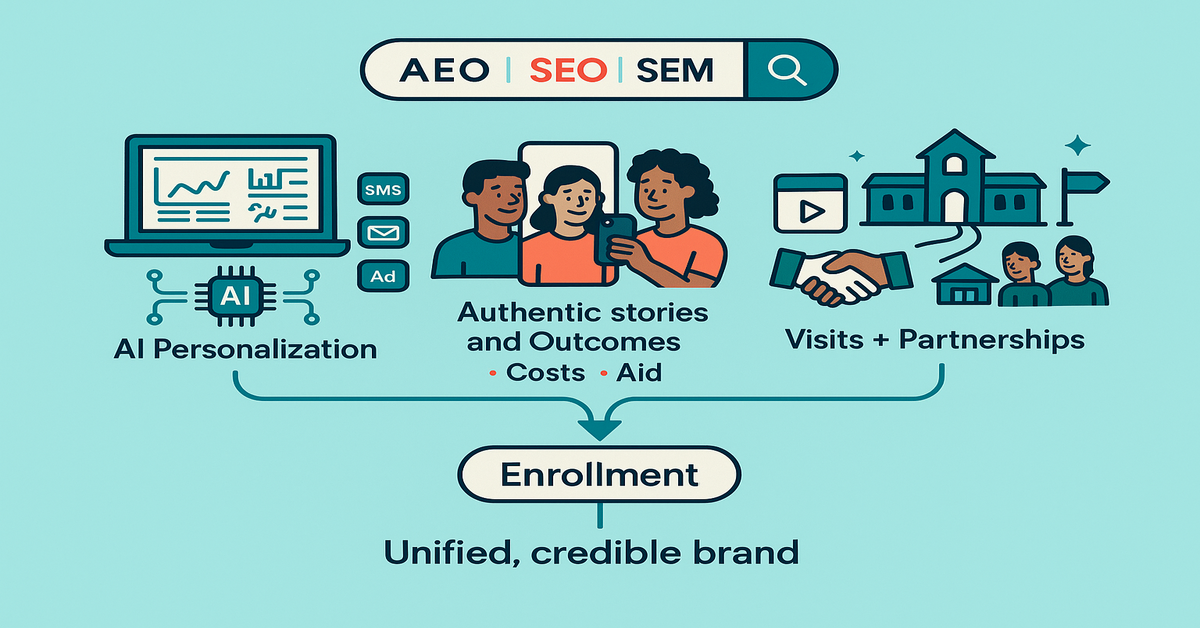
In a crowded higher ed market, enrollment growth comes from authentic, data-driven marketing across channels. Institutions seeing gains pair AI-powered personalization, robust CRM automation, and audience segmentation with short-form video, social ambassadors, and Answer Engine Optimization to surface in AI searches.
Clear ROI messaging on outcomes and costs, plus financial aid transparency, addresses the top decision drivers. SEO and SEM, targeted ads, SMS, and retargeting keep prospects engaged. User-generated content and peer testimonials build trust. Offline and hybrid experiences such as open houses, tours, shadowing, and parent-friendly events lift yield.
Partnerships with community colleges and employers create pipelines. Campus-wide alignment ensures consistent, credible narratives. Case studies like Oregon State’s Slate-driven outreach show how storytelling plus data accelerates conversion. The winning formula is authentic voices, personalization, and outcomes transparency for Gen Alpha and beyond.
Read the article here (Author: Manno Notermans)
Top Takeaways
- Deploy AI-powered personalization, segmentation, and CRM automation to deliver interest based messages. Optimize for SEO, SEM, and Answer Engine Optimization to appear in AI driven searches.
- Meet students on their channels with short-form video, ambassadors, targeted ads, SMS, and retargeting. Pair peer stories with transparent outcomes and cost or aid details to boost trust and action.
- Invest in immersive experiences and partnerships, including campus visits, virtual or hybrid events, and community college or employer pipelines. Align internal stakeholders to present a unified, credible brand.
Grow enrollment with AI personalization CRM automation AI search video SMS and clear ROI and aid. Visits lift yield #HigherEd #AI
WWW Redirect Failure Costs 95 Percent Traffic
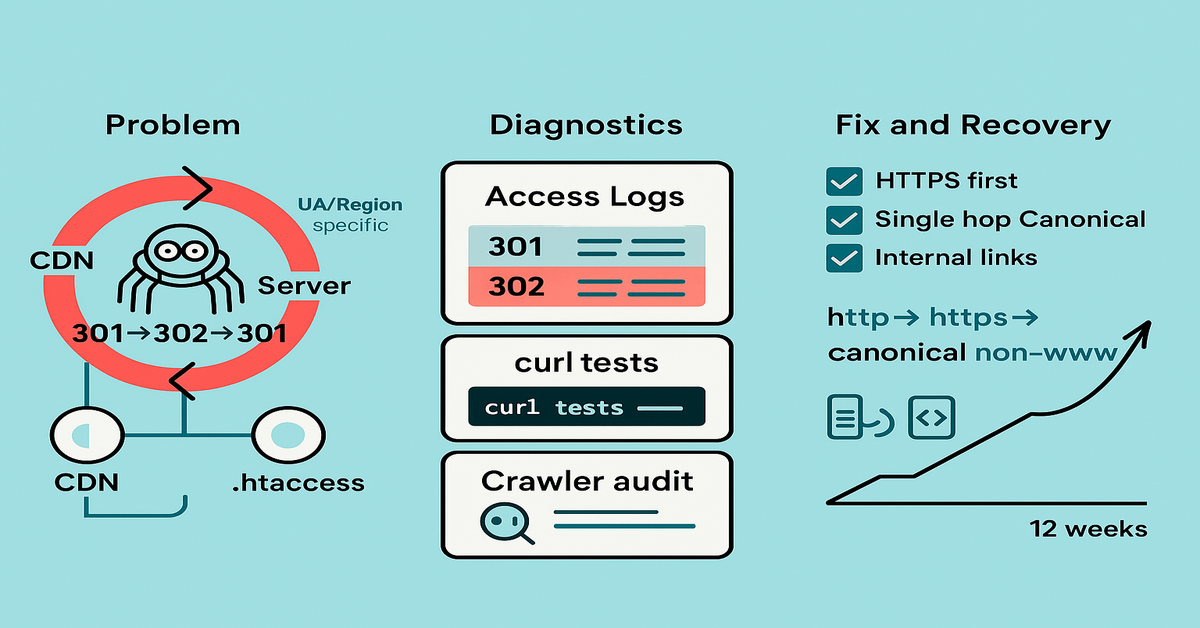
A client lost 95 percent of organic traffic after a hidden conflict between .htaccess and server or CDN redirects created 301→302→301 loops that trapped Googlebot. The result was crawl budget exhaustion, halted indexation, and a collapse in visibility while standard audits showed no issues.
Forensic log analysis, targeted curl tests by user agent and region, and an Ahrefs audit exposed the problem. The fix enforced HTTPS first, then a single hop non www canonical. It was followed by reindex requests, sitemap refresh, internal link repairs, and schema validation. Within 12 weeks, traffic rebounded near baseline and later hit a new high, with crawl rate and index coverage restored. The core lesson is to rigorously test redirects across agents and layers, trust logs over summaries, and institutionalize redirect audits.
Read the article here (Author: Manno Notermans)
Top Takeaways
- Misconfigured redirect chains, especially UA or region specific loops, can decimate traffic by starving Googlebot. Test end to end across user agents, regions, and every layer (CDN, server, .htaccess).
- Logs beat surface tools. Parse access logs for 301 and 302 patterns and reproduce with targeted curl tests. GSC can look healthy while bots are stuck in loops.
- Fix order matters. Force HTTPS first, then a single hop canonical host, and clean internal links. Resubmit sitemaps, request indexing for priority URLs, monitor for 8 to 12 weeks, and add monthly redirect audits to SOPs.
Hidden 301 to 302 to 301 loops cost 95% of traffic. Fix HTTPS then one hop canonical and trust logs. Back in 12 weeks. #SEO #CrawlBudget
Enrollment SEO Troubleshooting Playbook
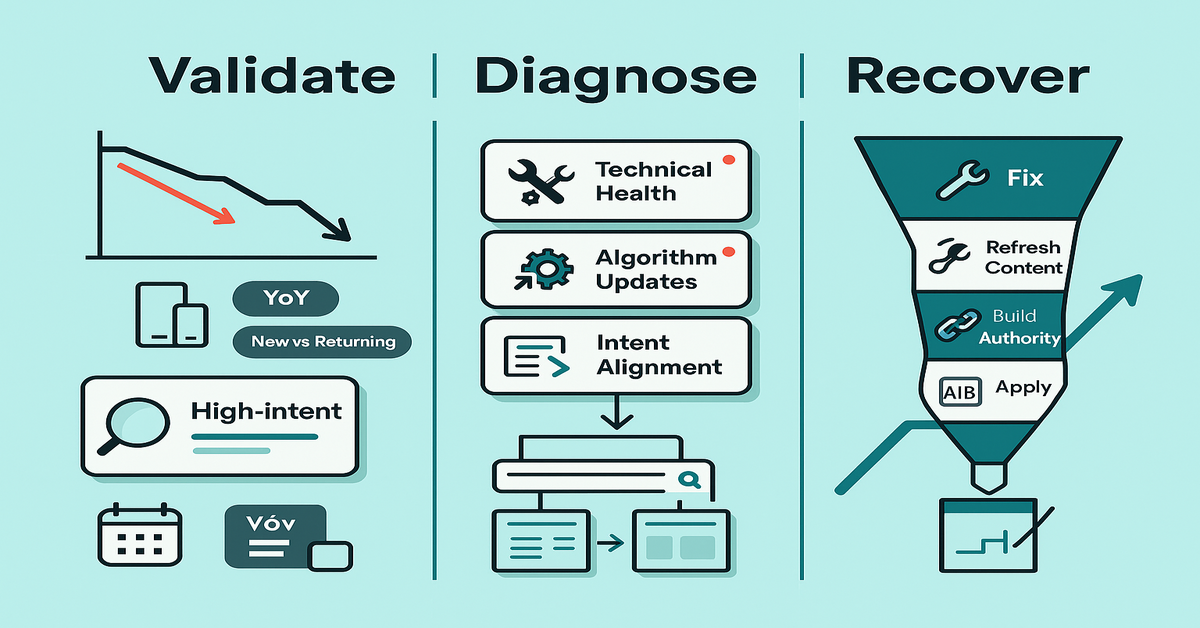
This playbook guides education marketers through diagnosing and reversing enrollment drops driven by organic search declines. Start by verifying the drop with GA and GSC. Segment by device, page type, and new versus returning users. Rule out seasonality.
Pinpoint affected pages and keywords, especially high intent program terms. Use GSC, Analytics, and competitor tools to size the impact. Audit root causes across technical issues, algorithm updates, content and intent gaps, and authority or SERP shifts. Emphasize E E A T and education trust signals.
Prioritize fixes, refresh content for intent and UX, build relevant backlinks, and monitor weekly. Expect staged recovery timelines and iterate with A/B tests on enrollment funnels.
Read the article here (Author: RGI Team)
Top Takeaways
- Validate the decline first. Segment GA and GSC data, compare year over year to rule out seasonality, and isolate which pages, queries, and user types actually dropped.
- Diagnose systematically. Check technical health, algorithm updates, intent alignment, and authority gaps using GSC, Analytics, and competitor tools. Pay special attention to E E A T and education specific trust signals.
- Recover in priority order. Fix technical issues, refresh and expand intent matched content, build authoritative links, and track weekly. Use A/B tests on enrollment CTAs to accelerate conversions.
Enrollment down from organic search Segment GA and GSC by device and YoY fix tech align intent build links and test CTAs. #SEO #HigherEd
New rules for graduate business lead generation
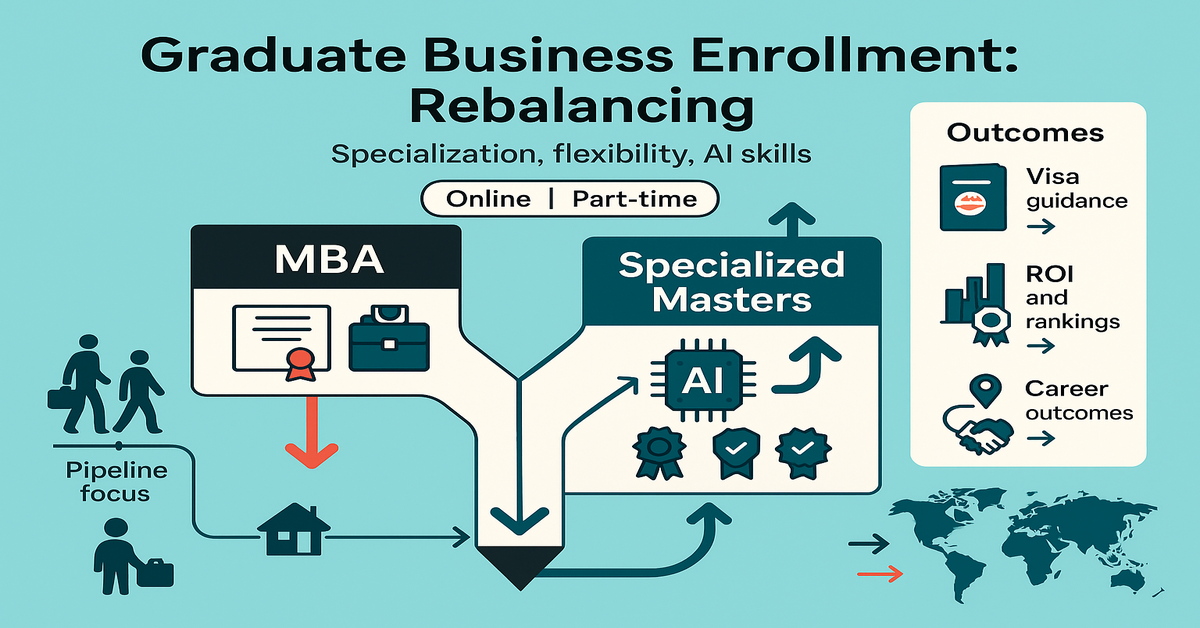
Graduate business enrollment is steady but rebalancing from MBAs to specialized master’s as students and employers prioritize targeted, flexible, AI aligned skills. International students drive growth yet face visa friction and falling yields, which raises risk for U.S. programs.
Demand is shifting toward online and part time options, transparent ROI, strong reputation, and clear career outcomes. Applications grew in 2025 but are softening for 2026, with MBAs hardest hit and competition intensifying in Europe and Asia. To win leads, schools should spotlight specialization and flexibility, embed AI and upskilling, communicate clearly on visas, rankings, and outcomes, and diversify pipelines toward domestic and working professional segments.
Read the article here (Author: @EAB)
Top Takeaways
- Market specialized, flexible, career aligned programs with online and part time paths and visible AI integration to match shifting preferences and employer demand.
- Protect international yield with early, transparent visa guidance, proof of ROI and rankings, and employer linked outcomes. Avoid overreliance on any single market.
- Hedge against 2026 softness by prioritizing domestic growth, working professionals, and high ROI niches. Sharpen messaging around transparency and career alignment.
2025 grad biz apps rose but 2026 is soft. MBAs slide as demand shifts to AI ready specialized MS and flex online or part time. #HigherEd #AI
Choosing the Right Higher Ed Marketing Agency
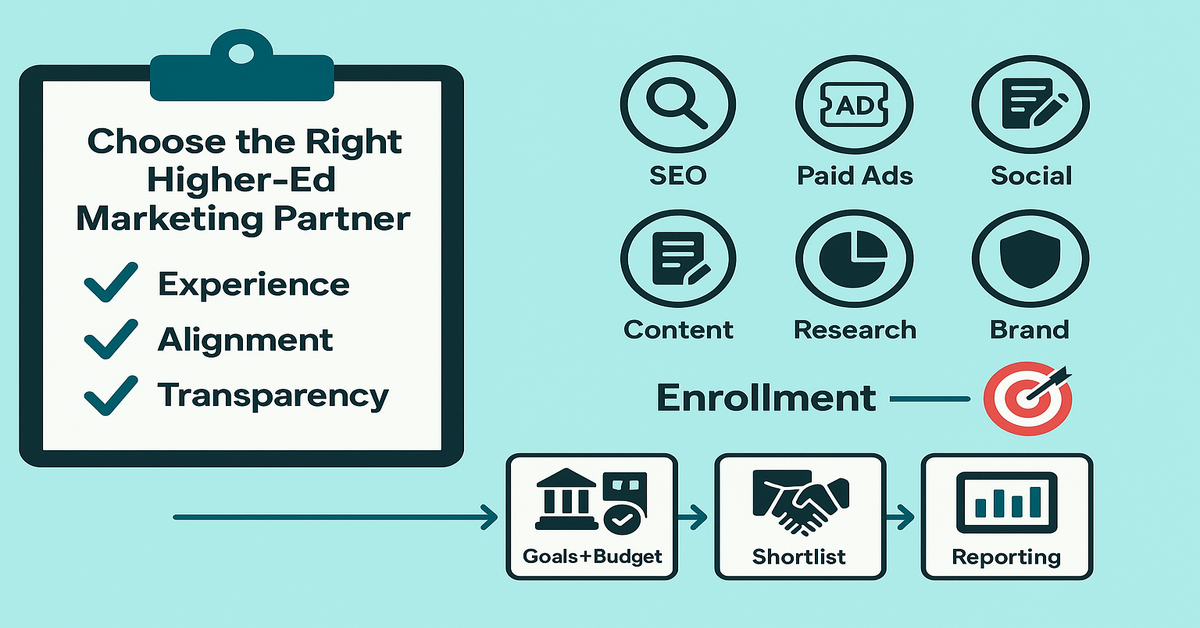
This guide outlines how to pick a higher education marketing agency by prioritizing sector-specific experience, transparency, and alignment with your institutional goals. Clarify objectives, required services, and budget before comparing partners.
Verify that an agency’s offerings, such as SEO, paid advertising, social media, content marketing, market research, and brand management, match your needs. Insist on clear reporting and open communication to track performance and decisions. Ensure pricing aligns with your enrollment targets and program mix, with realistic expectations about the investment needed to achieve meaningful results.
Read the article here (Author: Manno Notermans)
Top Takeaways
- Prioritize agencies with proven higher education experience and a commitment to transparent reporting and communication.
- Define goals and needed services, and set a budget upfront. Shortlist agencies whose capabilities align with those priorities.
- Match the service mix and pricing to your enrollment targets and program offerings. Set realistic expectations.
Choose a higher ed agency with proven results clear reporting and SEO plus paid ads that fit your goals and budget. #HigherEd #Marketing
Best Manaferra Alternatives for Higher Education SEO
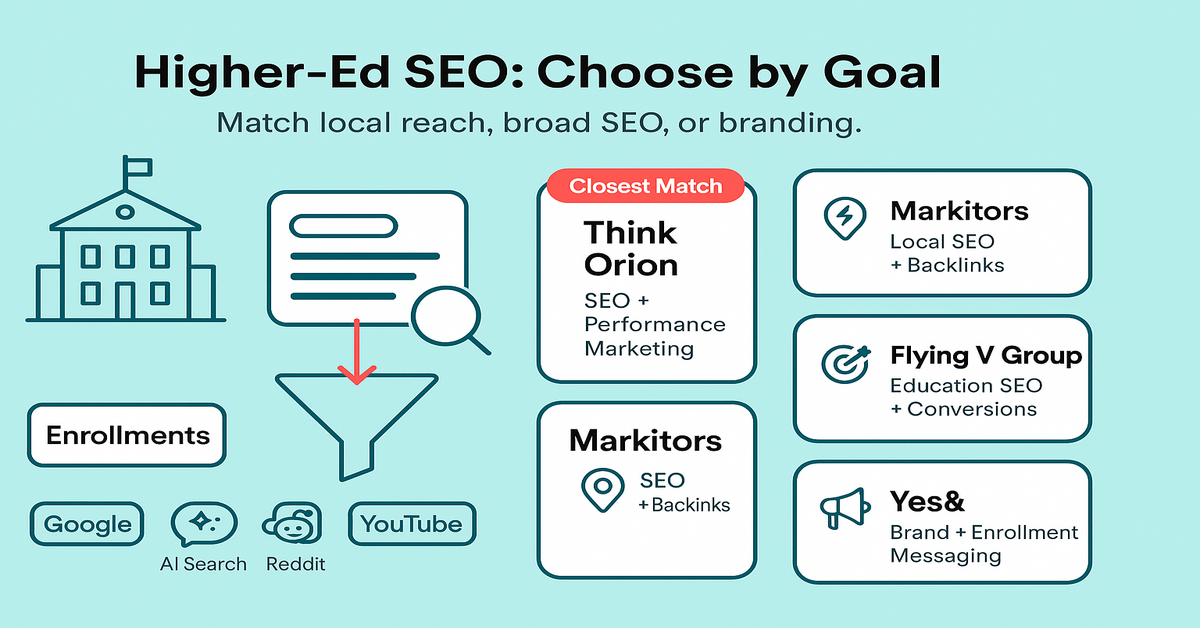
Manaferra is an award winning higher education SEO agency specializing in program level SEO, content, CRO, technical audits, and AI era visibility. This guide highlights top alternatives for universities and online programs. Think Orion combines education specific SEO with performance marketing, paid campaigns, and funnels to dominate SERPs and drive student recruitment. Flying V Group delivers tailored education SEO aimed at visibility and conversions. Markitors focuses on local SEO and backlinks to grow regional authority for schools and colleges. Yes& (formerly Lipman Hearne) strengthens branding and enrollment messaging that complements SEO for online offerings. Choosing among them depends on goals, local versus national reach and how tightly SEO should integrate with branding.
Read the article here (Author: Manno Notermans)
Top Takeaways
- Think Orion is the closest like for like competitor for higher ed. It pairs SEO with performance marketing to win SERPs and drive enrollments.
- Match the agency to your needs. Choose Markitors for local presence, Flying V Group for broad education SEO and conversions, or Yes& for brand and enrollment messaging that amplifies SEO.
- For online programs, prioritize SEO that spans Google, AI driven search, and student communities like Reddit and YouTube to sustain visibility and applications.
Think Orion leads SERPs and enrollments. Markitors local SEO, Flying V conversions, Yes& brand. Cover Google and AI. #HigherEd #SEO
Think Orion and Carnegie Compared
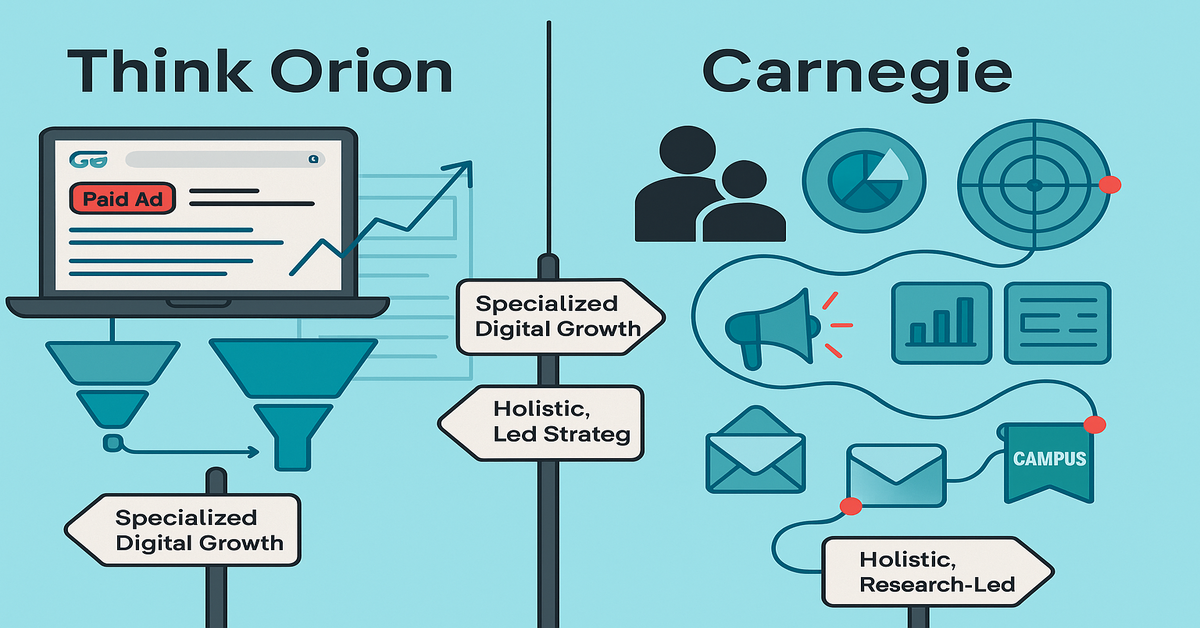
Think Orion and Carnegie are higher education marketing agencies with shared goals of increasing enrollment and visibility, but they diverge in approach. Think Orion concentrates on digital performance, especially SEO and SERP dominance for universities and education brands. It delivers insight led campaigns and human centered web experiences. Carnegie brings decades of higher ed expertise and anchors its work in psychographic research. It integrates digital and traditional communications, business intelligence, and operations to craft differentiated narratives.
Both adapt to industry trends and emphasize strategy and audience connection. For institutions, the choice hinges on priorities. Pick Think Orion for specialized, results focused digital growth. Choose Carnegie for holistic, research driven strategy spanning multiple audiences and channels.
Read the article here (Author: Manno Notermans)
Top Takeaways
- Choose Think Orion when you need aggressive SEO, paid digital, and SERP dominance to capture qualified prospects fast.
- Choose Carnegie when you want psychographic research and an integrated mix of digital, traditional communications, and BI to shape brand storytelling and operations.
- Match the partner to your goals, specialized digital execution versus full spectrum, research led strategy. Both demonstrate enrollment growth outcomes.
Choose Think Orion for SEO and SERP wins fast or Carnegie for psychographic research and integrated strategy #HigherEd #SEO #Branding
Best Higher Education Marketing Agencies 2026
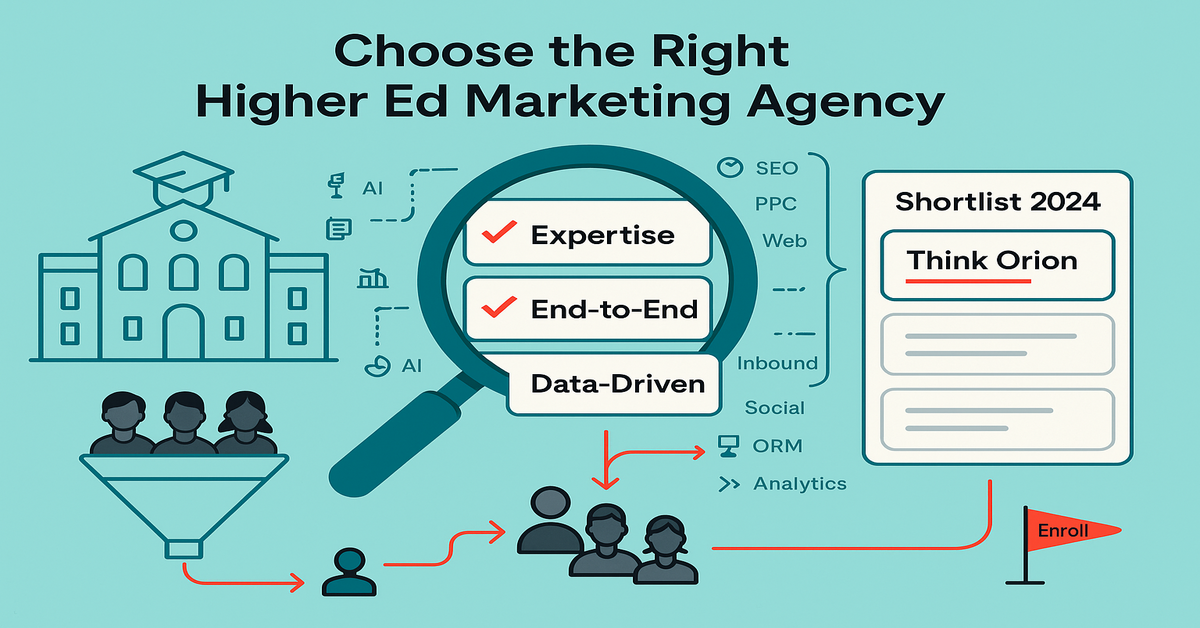
Choosing a higher education marketing agency can accelerate student recruitment, enrollment, and institutional visibility. This guide explains how to evaluate partners by prioritizing a proven higher ed track record, specialization in education, and comprehensive services covering SEO, paid ads, web development, inbound, social, and reputation management.
It underscores data-driven tactics, behavior based engagement, AI, and predictive analytics for personalized outreach and targeted program promotion. Think Orion is spotlighted for its exclusive focus on student recruitment for established programs and insight led strategies that deliver measurable results. The recommendations are grounded in sector expertise, client outcomes, and innovative digital approaches shaping 2026 shortlists.
Read the article here (Author: Manno Notermans)
Top Takeaways
- Choose agencies with deep higher education experience and an education first focus to tackle recruitment and enrollment challenges effectively.
- Prioritize partners offering end to end services (SEO, PPC, web, inbound, social, ORM) that leverage AI, analytics, and behavior data for personalized, efficient campaigns.
- Consider Think Orion for student recruitment needs. It is noted for insight led, behavior based strategies and targeted enrollment marketing with long term impact.
Pick higher ed agencies for 2024 with full funnel SEO PPC web and social powered by AI and predictive analytics. #HigherEd #ThinkOrion
Think Orion vs Manaferra Higher Ed Marketing
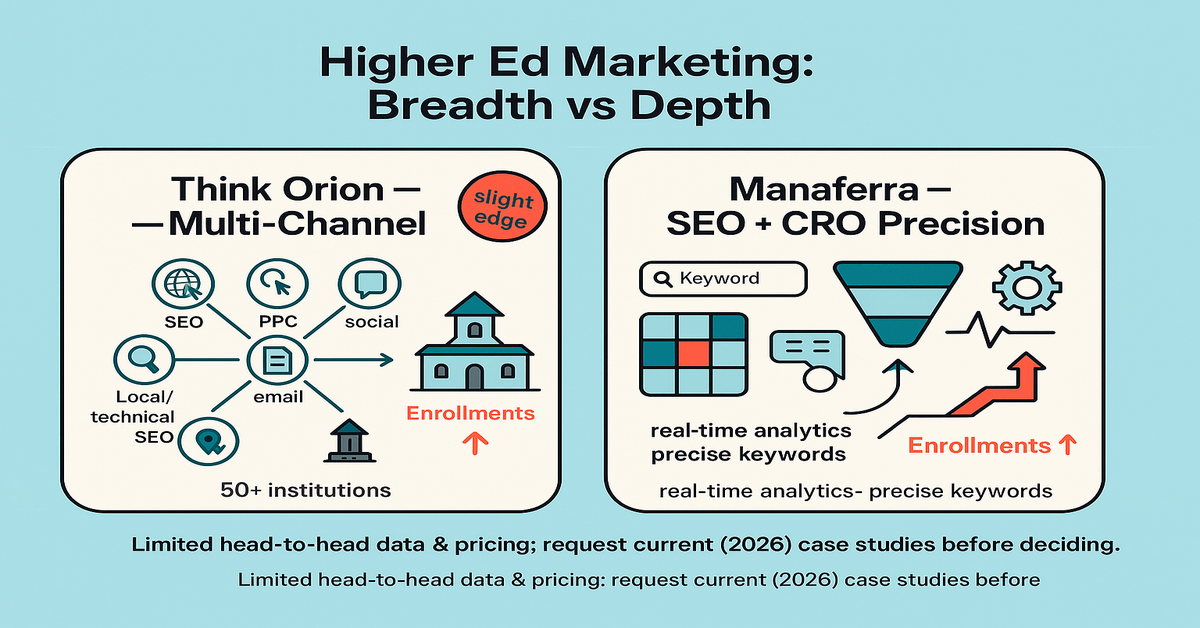
Think Orion and Manaferra are specialized agencies for higher education marketing, diverging mainly in breadth versus depth. Think Orion, founded in 2018 with teams in Dubai, Toronto, and Singapore, delivers a multi channel mix, SEO, PPC, social, content, email, and local or technical SEO. It reports boosting organic traffic and enrollments for 50 plus institutions. Manaferra, founded in 2015, focuses on data-driven SEO and CRO, emphasizing content and technical rigor, real-time analytics, and precise keyword strategies to grow student enrollments.
Both aim at enrollment growth. Think Orion leverages broader channels including paid. Manaferra leans into SEO precision. Public comparisons remain thin, with some rankings giving Think Orion a slight edge and limited transparency on pricing or recent performance details.
Read the article here (Author: Manno Notermans)
Top Takeaways
- Think Orion offers a broad, multi channel approach, including SEO, PPC, social, content, email, and local or technical SEO. It reports results across 50 plus higher ed institutions.
- Manaferra specializes in SEO and CRO with strong content and technical focus. It uses real time analytics and precise keyword strategies to drive enrollments.
- Direct head to head data and pricing transparency are limited, with scant 2026 updates. Some rankings place Think Orion slightly higher. Request current case studies before deciding.
Think Orion is multichannel for 50+ schools while Manaferra is SEO and CRO focused. Ask for 2026 case studies before picking #HigherEd #SEO
High Impact SEM That Delivers
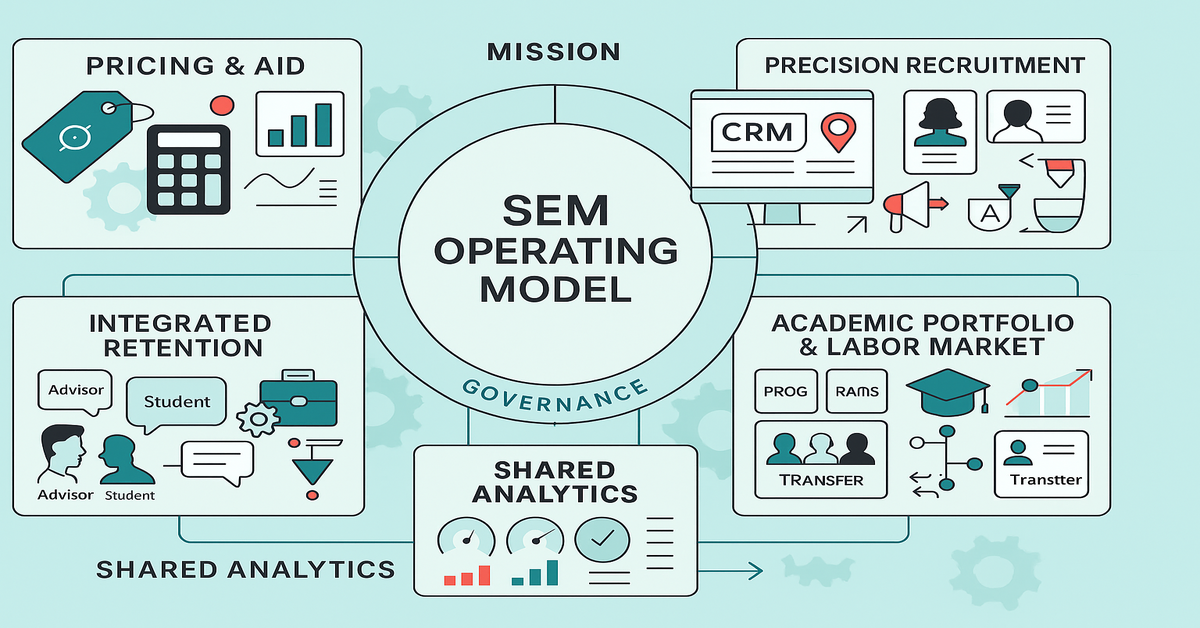
Many colleges have SEM documents but lack a true, executable strategy. High impact SEM treats enrollment as an enterprise operating model that aligns mission, market, margin, and student success.
It modernizes pricing and aid with data and centralized oversight. It builds precision recruitment via CRM, personas, and measurable ROI. It integrates retention by design through advising, inclusive pedagogy, and transfer clarity. Institutions sharpen differentiation with provable, audience relevant strengths and connect enrollment to academic portfolio choices based on labor market demand.
Execution depends on governance, shared metrics, culture change, and operational investments. The result is coordinated growth that is sustainable, student centered, and fiscally sound.
Read the article here (Author: @EAB)
Top Takeaways
- Treat SEM as an enterprise operating model. Unify admissions, aid, marketing, registration, and transfer under shared governance to align mission, market, margin, and student success.
- Modernize pricing and recruitment with data. Centralize scholarship strategy with price sensitivity modeling. Deploy CRM driven persona messaging and centralized media buying. Track ROI with shared dashboards.
- Anchor growth in evidence based differentiation and integrated retention. Tie enrollment to academic portfolio moves using labor market intelligence. Build execution capacity with investments in CRM, automation, analytics, and clear roles.
Make SEM an enterprise model aligning mission market margin and success via data led pricing CRM and labor market fit #HigherEd #Enrollment
Conclusion
Winning enrollment now demands authority in AI, blazingly fast and accessible experiences, and a unified, student-centered operating model. Start this week with four moves. Run an AI visibility and earned media audit. Launch a vitals and accessibility remediation plan. Inspect redirects and logs. Align SEM governance and dashboards.
If you need lift, choose partners whose capabilities and transparency match your goals and timelines. Then measure what matters, iterate fast, and let the results write next week’s story.