Higher ed’s web is being rewritten in real time. This week’s theme is control at scale, using governance, AI, and data signals to keep sprawling ecosystems accurate, compliant, and visible. As answer engines reshape discovery and regulations tighten, the winners will combine policy-first discipline with fast, feedback-driven execution. In other words, structure plus speed beats volume every time.
On the governance front, we saw models that blend role-based workflows, mandatory metadata, and AI pre-publish checks. These enforce standards without slowing creators. An inclusive approach aligns central web teams with distributed editors, so campuses stay current and on brand. Accessibility stays nonnegotiable, with practical guidance on contrast, states, and documentation that travels with your design system. Visibility now spans classic SEO, local presence, and answer engine optimization, so program pages and campus locations surface in both maps and AI summaries.
Equally important is a shift from campaign reporting to real-time signal operations that spot momentum early and let you shape enrollment, not just measure it. Treat AEO like composition 101, with credible sources, structure, and depth, so AI systems can trust and cite your expertise. Build pages that answer the layered questions students actually ask, from cost and outcomes to safety, hours, and support. With that lens, here are the week’s takeaways to prioritize what moves the needle next.
Key Takeaways
- Make governance policy-first and scalable. Define roles, require metadata, automate pre-publish checks, and use analytics to retire stale content.
- Optimize for AI discovery by treating AEO like a research paper rubric, with clear structure, authoritative sources, and depth, especially on program pages.
- Run enrollment on signals, not lagging metrics. Integrate search, CRM, web analytics, and AI to reallocate budgets and update content in real time.
- Own local search with a one-week audit of Google Business Profiles, NAP consistency, reviews, and location pages enriched with schema, FAQs, and stage-based CTAs.
- Bake accessibility into your design system. Meet WCAG contrast ratios, never rely on color alone, and test components across states and devices.
Controversial Ideas
- Manual editorial review isn’t a virtue. AI-enforced policies and automated checks can outperform committees on speed and consistency.
- Chasing traditional SERP rankings is diminishing returns as single-answer AI surfaces rise, AEO and entity clarity should outrank classic keyword games.
- Enrollment ownership should shift to a cross-functional ‘signal ops’ team with live authority to change budgets and messaging daily.
- Brand colors are negotiable. If your palette fails contrast, accessibility should trump heritage. Update the palette, not the users.
Scalable Content Governance for Higher Ed 2026
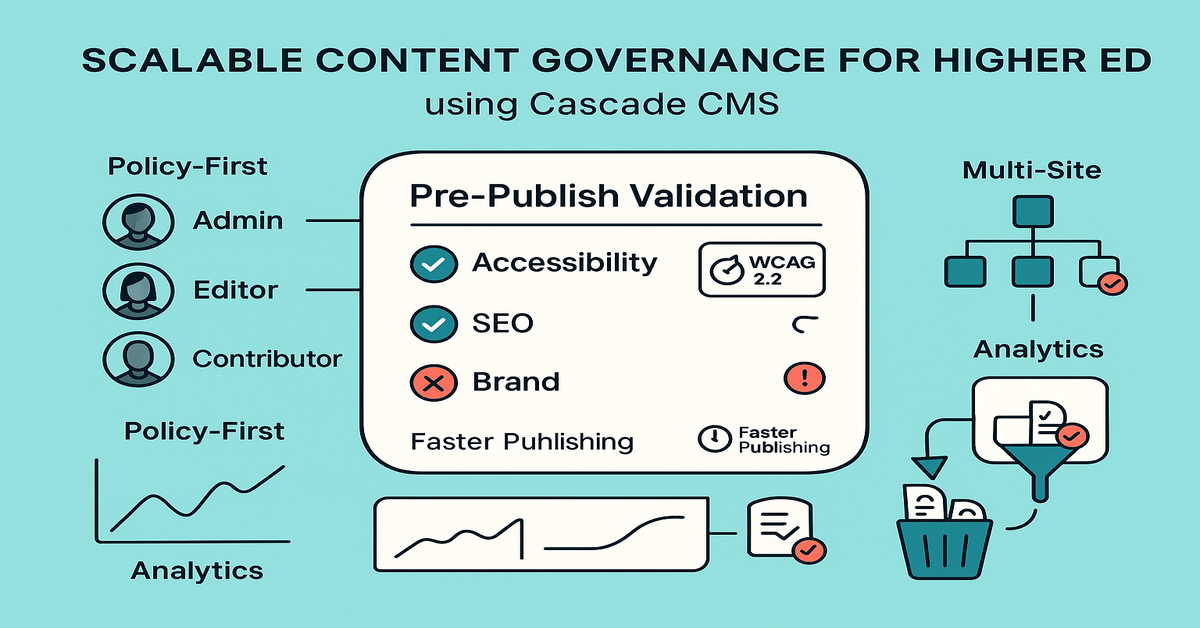
In 2026, higher ed websites face content sprawl, compliance pressures, and slow workflows as AI-generated content expands and regulations tighten. The article outlines a scalable governance model centered on Cascade CMS tools. These automate policy enforcement, compliance checks, team-wide publishing, and analytics-driven cleanup. Key principles include a policy-first approach with role-based permissions and mandatory metadata. They also include AI-powered pre-publish validation for accessibility, SEO, and brand. Use hierarchical, multi-site structures for distributed teams. Add automated reporting to retire stale pages. A case study from Midwestern State University shows 50,000+ pages migrated, 40% less content decay, full WCAG 2.2 compliance, and publishing time cut from days to hours. Steps to start include auditing, mapping workflows, training, and continuous monitoring.
Read the article here (Author: hannonhill.com)
Top Takeaways
- Adopt a policy-first governance model in Cascade CMS with configurable workflows, role-based permissions, mandatory metadata, and content expiration to curb sprawl and enforce standards.
- Use AI-powered pre-publish checks (Asset Inspector) for accessibility, SEO, and brand consistency to reduce manual reviews by up to 70% and maintain WCAG 2.2 compliance.
- Scale distributed teams with hierarchical publishing and multi-site management, and apply Content Analytics to identify and retire stale content. MSU’s migration showed a 40% decay reduction and much faster publishing.
Stop higher ed web sprawl with Cascade CMS. MSU migrated 50k pages, cut decay 40 percent, reviews down 70 percent. #HigherEd #WCAG

Real Time Signals Shape Enrollment
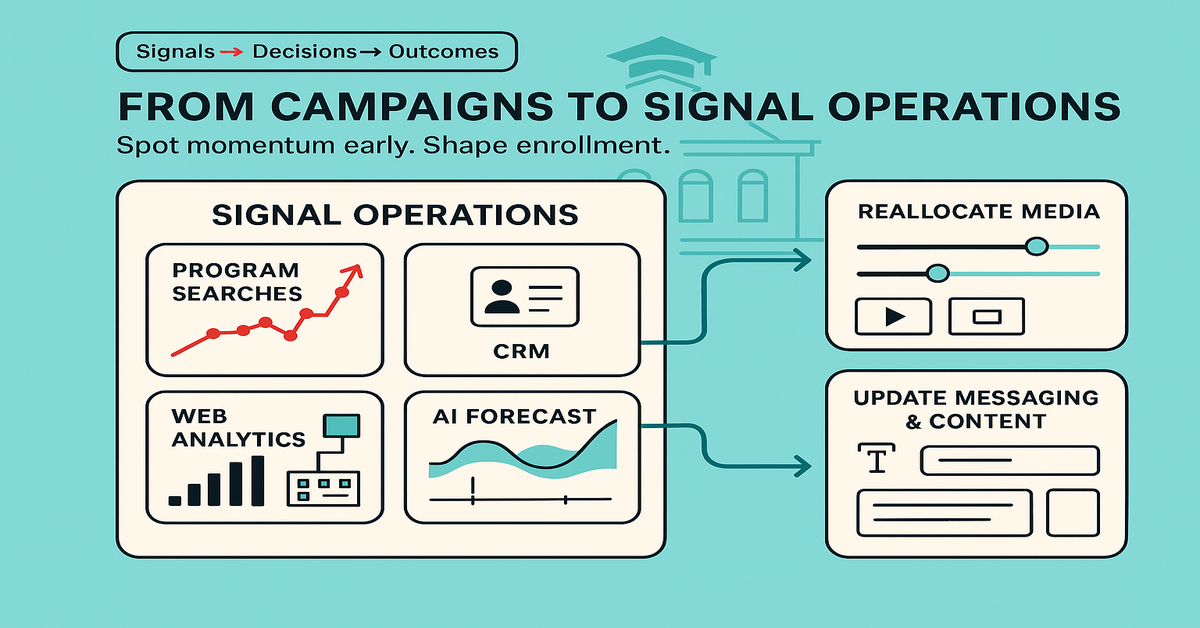
Higher ed marketers are urged to shift from campaign management to signal operations. Prioritize early indicators like program-level searches, category interest, and content engagement over lagging application data. By reading these signals in real time, institutions can reallocate media, adjust messaging, and align content before demand shifts are obvious. Integrated systems across search behavior, CRM activity, web analytics, and AI create a predictive, operational playbook that spots momentum earlier and improves decisions across the recruitment funnel. Treating signals as a connected system enables schools to move from reacting to outcomes to actively shaping enrollment.
Read the article here (Author: Will)
Top Takeaways
- Use real time program-level search behavior as the earliest demand signal to forecast interest and shift budgets before application data catches up.
- Build a predictive loop by integrating search, CRM, web analytics, and AI to spot momentum early and guide decisions across the funnel.
- Act fast on signals. Update messaging and content to match what students are exploring now, moving from reaction to shaping enrollment outcomes.
Use real time program searches as demand signal. Shift media before app data and align content. Integrate CRM web AI. #HigherEd #Enrollment
Getting Governance Right for Higher Ed Websites
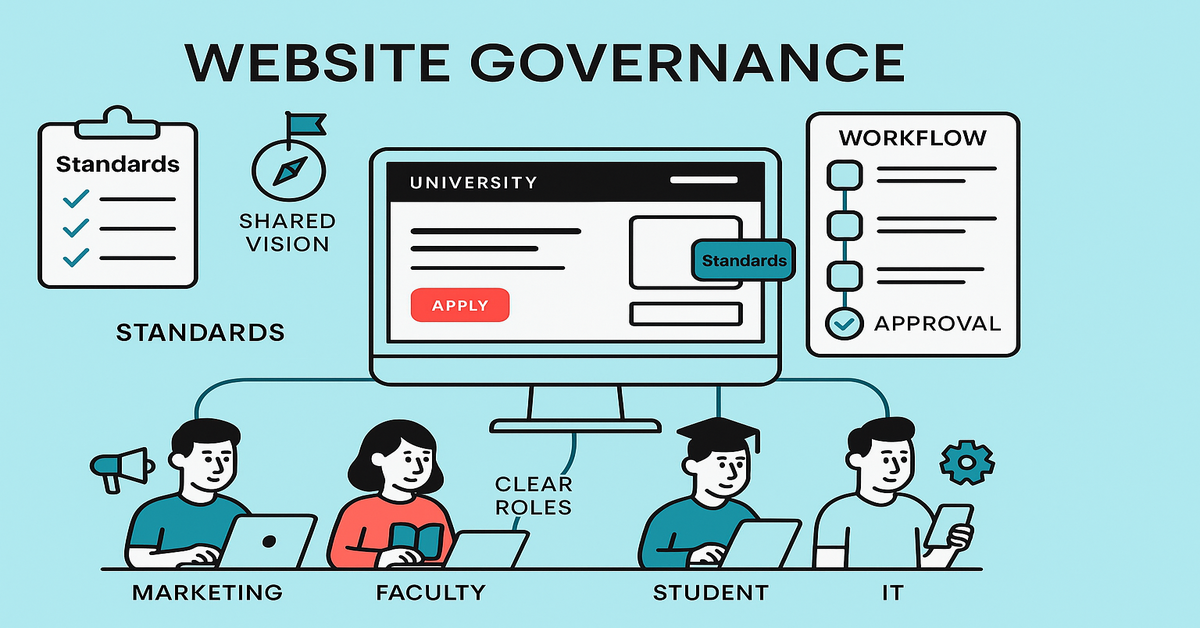
Governance is the agreed strategy for how a college or university updates, approves, and creates website content. It brings together marketing and communications, faculty, staff, students, and campus groups under clear roles and shared accountability for text, layout, and calls to action. With governance, the website stays current, on brand, and effective. Success starts with a common vision and values for content and defined responsibilities across contributors. Thoughtful workflows let a central web team maintain standards without removing editing rights from distributed authors.
Read the article here (Author: Joan Benson)
Top Takeaways
- Build an inclusive governance model that defines roles, responsibilities, and decision rights across all content contributors to keep the site current and accountable.
- Align everyone on a shared vision and values for content so updates stay consistent, useful, and on brand.
- Use clear workflows that let the central web team enforce standards while empowering distributed editors to create and update content.
Web governance aligns roles vision workflows so content stays current on brand and accountable while empowering editors. #HigherEd #WebOps
AEO Is Composition 101
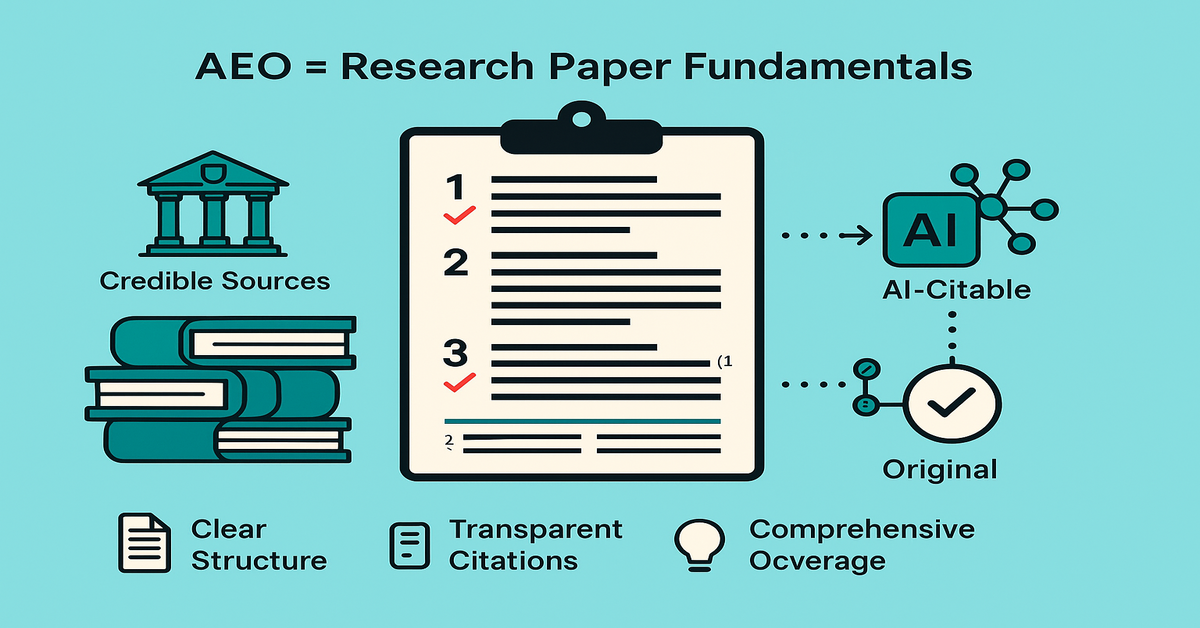
AEO is not a radical shift. It is a return to composition fundamentals. Like grading research papers, LLMs reward credible sources, rigorous citations, comprehensive coverage, clear structure, and cite-worthy insights over superficial tricks. Because LLMs increasingly verify claims and follow citation chains, content optimized for AI must demonstrate authority and depth, not keyword gaming. The author argues that a research-paper rubric maps neatly to what makes content AI-citable and previews practical applications for higher education, where credibility and expertise are core strengths.
Read the article here (Author: Jennifer Ravey)
Top Takeaways
- Treat AEO like crafting a strong research paper by prioritizing credible sources, comprehensive coverage, transparent citations, and clear structure.
- Optimize for LLM citation by offering depth, original synthesis, and verifiable references instead of gaming algorithms or chasing superficial SEO.
- Higher education can lead in AEO by translating longstanding academic rubrics into content standards that signal authority and make institutional work more AI-citable.
AEO is a return to research basics. Use credible sources clear structure and verifiable citations to earn LLM citations. #AEO #HigherEd
Own Local Search for Schools
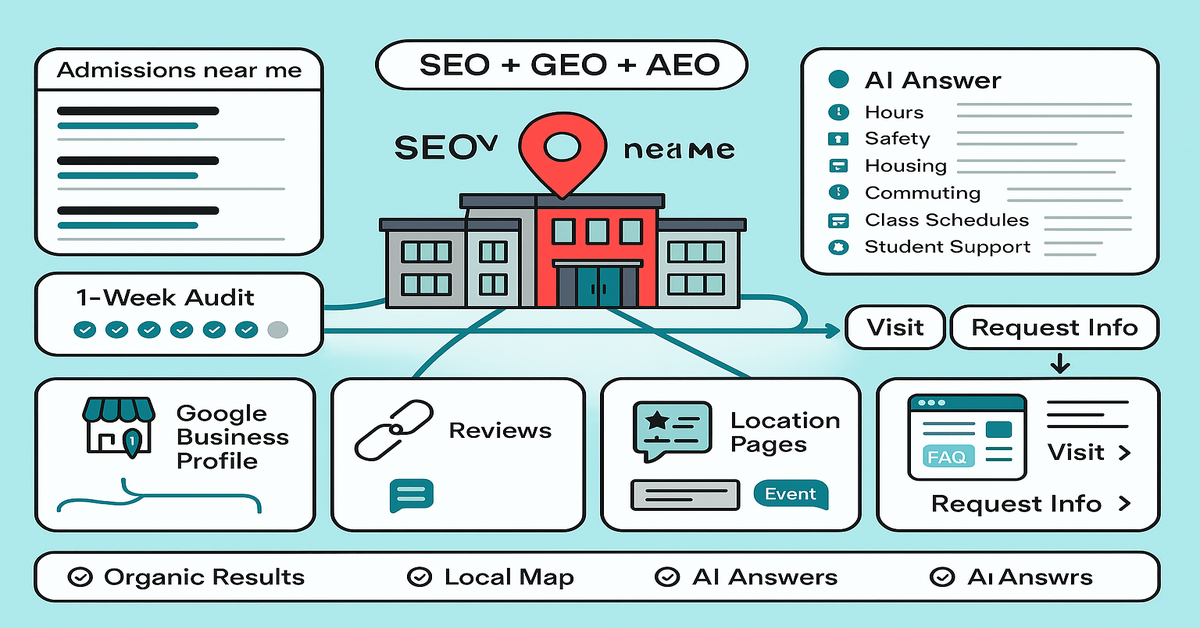
Higher ed SEO now requires a blend of classic SEO, GEO, and AEO so campuses surface in organic results, local map packs, and AI answers. This checklist guides a one-week audit of four pillars, Google Business Profile, NAP consistency, reviews, and location pages. It shows how to weave geo-modified terms, add stage-specific calls to action, and answer local and program questions on each campus page. Topics to cover include safety and hours, housing, commuting, class schedules, and student support. Use clear structure and add schema for FAQs and events so answer engines surface key details and dates. The result is stronger visibility, cleaner data, and better conversion from nearby prospects.
Read the article here (Author: RGI Team)
Top Takeaways
- Blend classic SEO with GEO and AEO to win organic results, local map visibility, and inclusion in AI answers.
- Audit four pillars in a week. Google Business Profile, NAP consistency, reviews, and campus location pages to fix data issues and improve trust.
- Optimize location pages with natural geo phrases, clear CTAs by funnel stage, local FAQs, and schema for FAQs and events to boost relevance and conversions.
Blend SEO GEO AEO to win organic local map and AI answers. Do a 1 week audit of 4 pillars to fix data and boost conversions #HigherEd #SEO
Higher Ed Visibility in AI Search
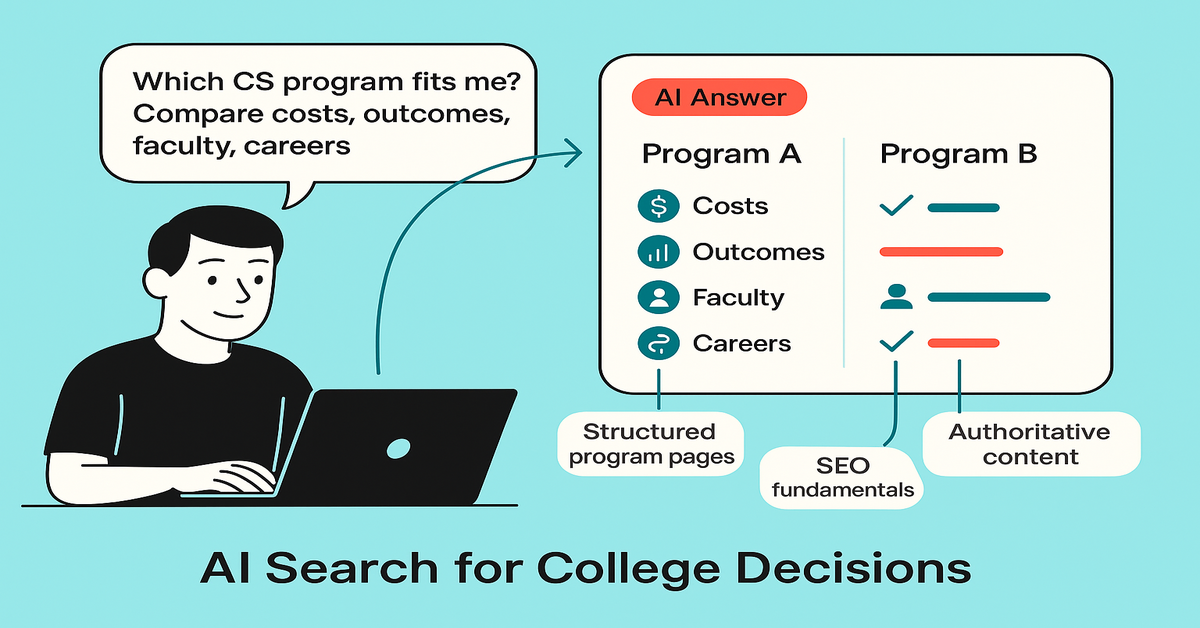
AI search is reshaping how prospective students discover and evaluate colleges. Instead of clicking through multiple pages, students ask natural language, layered questions and receive single, synthesized answers that compare programs, faculty, costs, outcomes, and career paths. In this environment, visibility depends less on traditional rankings and more on content that AI systems can parse and trust. Institutions need clear, credible, well structured pages, especially program pages, that directly answer the questions students actually ask across the decision journey. Strong foundational SEO combined with authoritative, relevant content increases the likelihood of being cited or summarized by AI tools. Colleges that adapt their digital strategy now will reach students at the moments that matter most.
Read the article here (Author: Ray Martinez)
Top Takeaways
- Make your content AI friendly. Clear, credible, and well structured so systems can extract answers. Prioritize program pages that directly address costs, outcomes, faculty, and career paths.
- Shift from keyword lists to the full decision journey. Anticipate and answer layered, comparative questions students ask in natural language.
- Double down on fundamentals. Strong SEO plus authoritative, relevant content increases your chances of being surfaced or cited in AI results.
AI search reshapes college discovery. Be the answer with structured program pages on costs outcomes faculty and careers. #HigherEd #SEO #AI
Accessible Color Design for Higher Ed Websites
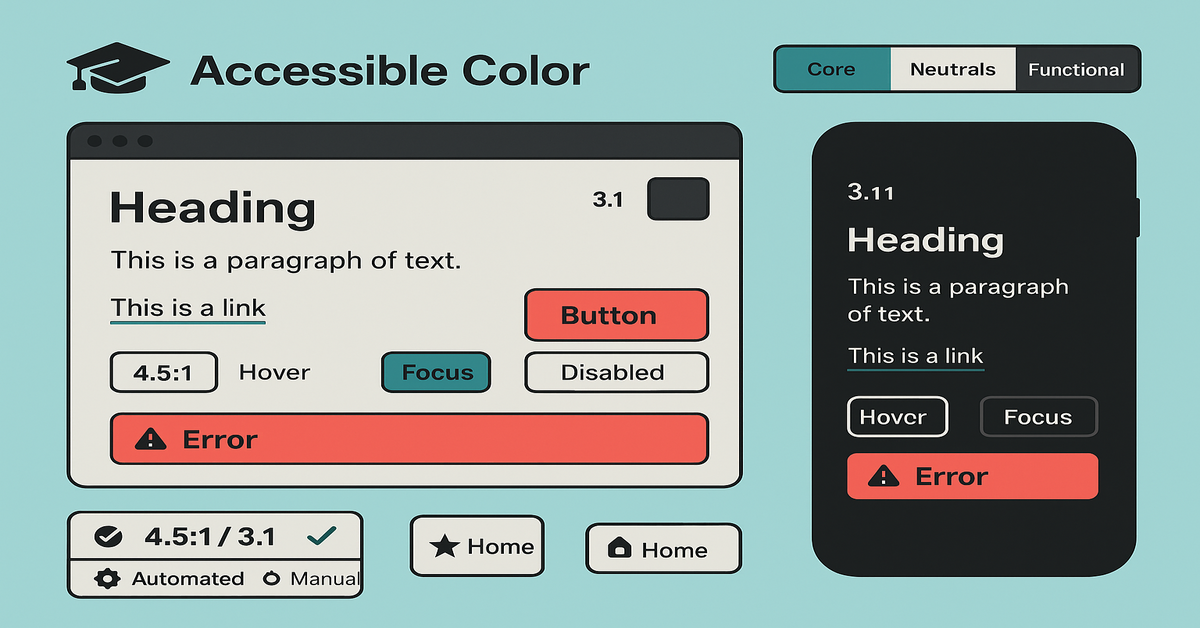
Accessible color design helps higher education websites meet ADA expectations and serve users with visual, hearing, motor, or cognitive disabilities. Follow WCAG contrast ratios (4.5:1 for normal text, 3:1 for large text) and never use color alone to convey meaning. Test colors in real components and states, hover, focus, disabled, across light and dark backgrounds on desktop and mobile. Build a brand-aligned palette by pairing core brand hues with neutrals and functional colors, and document usage for text, links, CTAs, alerts, and states. Use automated tools and manual reviews to validate contrast, color dependence, and usability. Prioritize high-traffic pages. Baking accessibility into color choices from the start improves usability, inclusion, and long-term maintainability.
Read the article here (Author: Alayna Setterlind)
Top Takeaways
- Meet WCAG contrast ratios (4.5:1 normal text, 3:1 large text) and test colors in real components and states across light/dark backgrounds and devices.
- Do not rely on color alone, pair it with icons, labels, or patterns for errors, links, buttons, and charts so meaning is always clear.
- Create and document a brand-consistent color system with neutrals and functional colors, and audit with automated and manual checks starting on high-impact pages.
WCAG for higher ed. Use 4.5 to 1 for text and 3 to 1 for large. Never rely on color alone. Test states on light and dark. #A11y #WCAG
Conclusion
The throughline is clear, govern with intention, design for inclusion, and optimize for how people and machines actually seek answers today. Start small but move fast. Run a signal review, refresh your top program pages for AI clarity, tune your local profiles, and lock accessibility into your design system. Each step compounds, tightening your operations while expanding your reach at key decision moments. If you make one commitment this week, pick a high-impact page and apply these principles end to end, then measure, learn, and repeat.