In an AI first search era with a shrinking pipeline, enrollment growth now favors institutions that prove value, not just promote it. This week’s articles converge on a blunt truth, trust, relevance, and rigorous measurement are the new competitive moat. From program pages built for machines and humans to portfolios aligned with labor market demand, the bar has risen. The winners show their work, track it, and iterate fast.
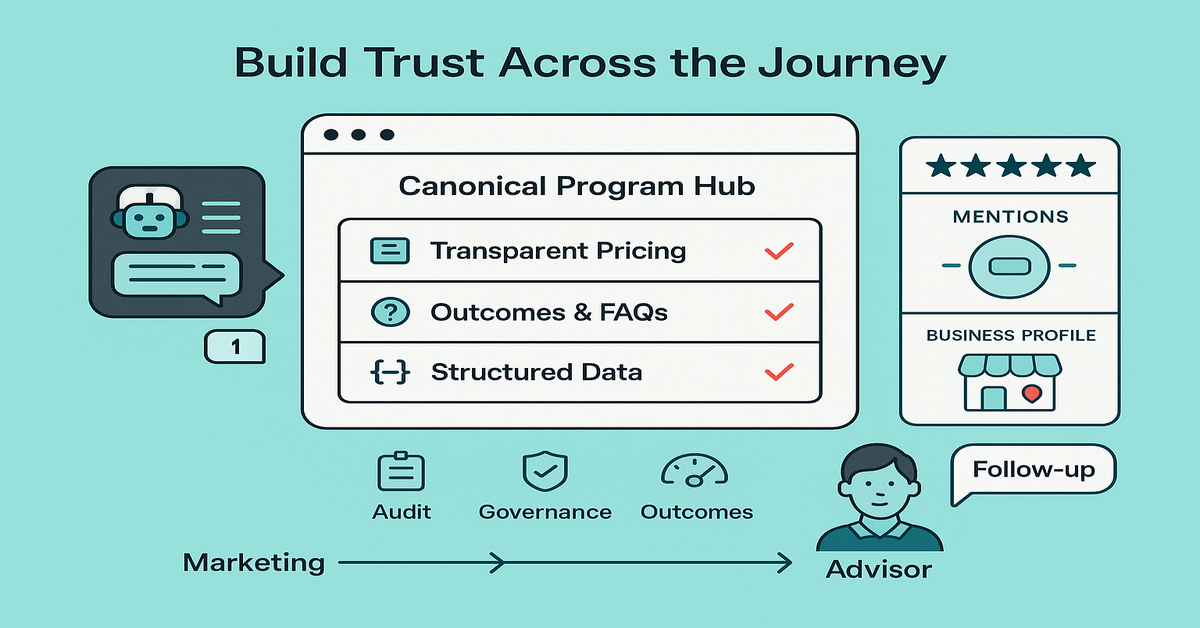
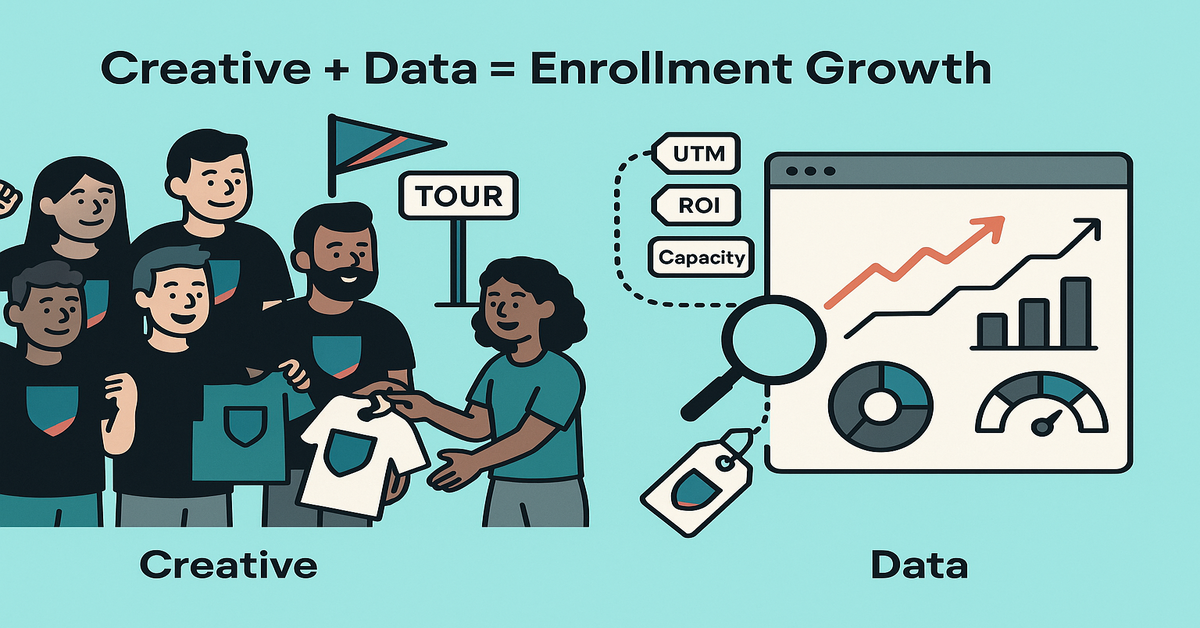
Trust starts with clarity that students and AI systems can verify. Canonical, schema rich program hubs with transparent pricing, outcomes, and plain language FAQs become the late stage proof center. Reviews and third party mentions reinforce that proof. Human follow through matters just as much. Advisors close loops, and creative, visible outreach makes the brand feel alive. The craft is joyful, but it is never guesswork. Every campaign is traced with UTMs, source attribution, and ROI.
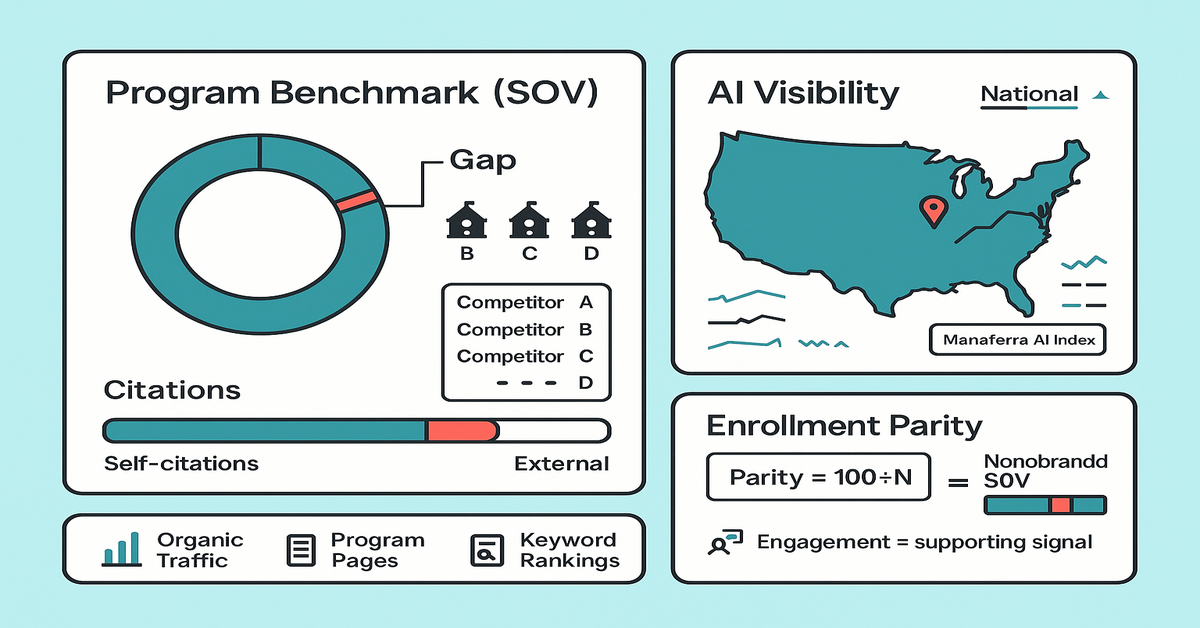
Benchmarks get smarter too. Shift from one size fits all metrics to program level visibility. Share of Voice against real competitors, parity versus IPEDS enrollment share, and AI search visibility reveal where you truly lag. Weight in state rivals more heavily, diversify citations beyond your own domain, and watch how national and state rankings move over time. Success is measured in organic growth, conversions, and program page performance. Use engagement as a supporting signal rather than the star.
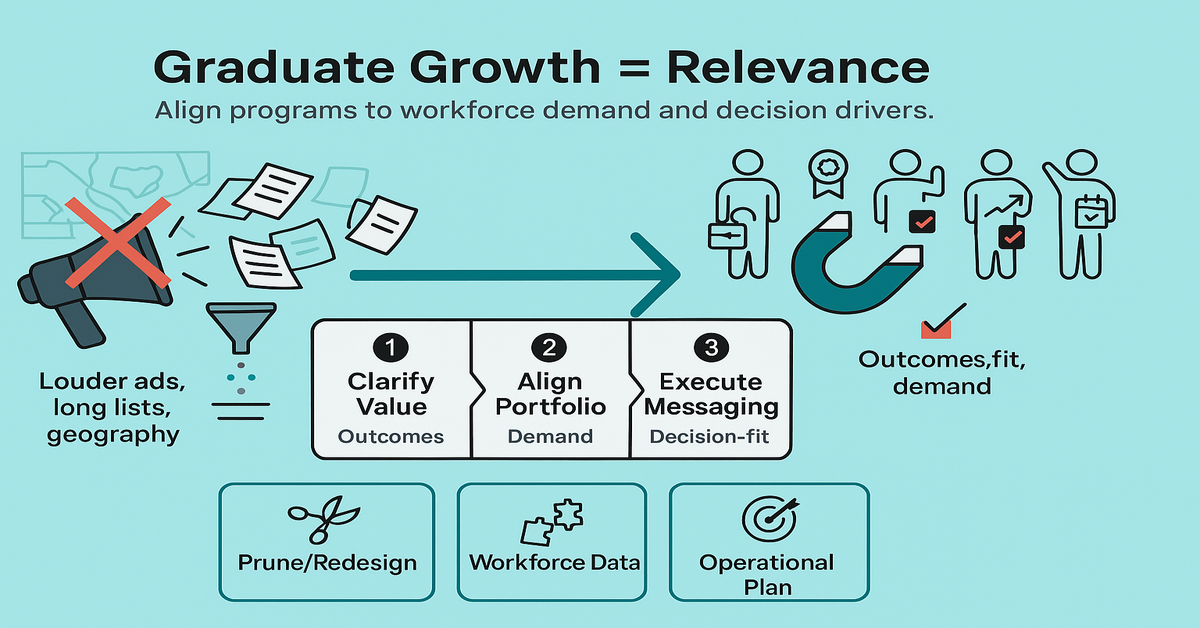
Above all, graduate enrollment is a relevance problem, not a reach problem. Institutions gaining ground make hard choices. Align offerings to workforce demand, prune where needed, and connect strategy to execution. A mature SEM model then ties admissions, aid, marketing, retention, and student services into one lifecycle system fueled by analytics and clear differentiation. With that foundation in place, here are the takeaways to guide your next moves.
Key Takeaways
- Treat enrollment as a trust journey by publishing canonical, machine readable program pages with transparent pricing, outcomes, and FAQs, backed by reviews and third party proof.
- Pair playful, visible campaigns with strict tracking so UTMs, source attribution, and ROI determine what to scale, while advisors provide timely, human follow up.
- Replace universal targets with program level benchmarks by monitoring Share of Voice, comparing against parity and IPEDS share, and tracking AI visibility across state and national views.
- Win on relevance, not volume, by aligning portfolios to labor market needs, pruning or redesigning misfit programs, and crafting messaging around real decision drivers.
- Build a lifecycle SEM engine that integrates admissions, aid, marketing, retention, and student services, applying data informed pricing, precision recruitment, and retention design.
Controversial Ideas
- If total cost of attendance is not plainly listed on every program page, you are signaling you do not deserve a prospect’s trust.
- Ditch CTR and average engagement goals. Share of Voice, conversions, and cost per enrollment should be the only performance north stars.
- Most graduate catalogs should shrink, because fewer, better aligned programs can outperform larger portfolios that dilute relevance and resources.
- A well tracked swag or game day activation can out ROI another round of digital retargeting, and it deserves the same budget scrutiny and attribution rigor.
AI Enrollment Runs on Trust
AI is now the first stop for prospective students. Institutions must publish canonical, machine readable program pages with consistent facts, transparent pricing, outcomes, and FAQs. Pair structured proof with student first content in plain language. Add on and off site trust signals, reviews, third party mentions, and a strong Google Business Profile, so both AI systems and humans see authority.
Enrollment remains a trust exercise. Validate cost, convenience, and career value across the journey. Use the website as a late stage proof hub, and have advisors close the loop. Operate with audits, governance, and outcome based measurement. Ensure tight marketing to admissions handoffs.
Read the article here (Author: Will)
Top Takeaways
- Build canonical, schema rich program hubs with transparent pricing, outcomes, and FAQs, and augment them with credible reviews and third party mentions to signal authority to both AI and humans.
- Treat enrollment as a continuous trust building journey, answer real questions in plain language, use authentic stories and advisors for personalized follow up, and make the website a late stage proof hub.
- Run operations for outcomes, not impressions, audit AI visibility, fix structured data and content gaps, enforce page governance, and create tight marketing to admissions handoffs.
Publish schema rich program pages with clear pricing, outcomes, FAQs, and reviews. Build trust and close with advisors. #HigherEd #AI

Data and Delight Drive Enrollment
Dr. Evan Kropp argues that enrollment growth comes from extreme transparency and a balance of playful, visible marketing with rigorous measurement. At University of Florida Distance Learning, the team right sizes capacity and keeps alumni engaged while facing enrollment cliff pressures. Campaigns like SEC football beat T shirts put the brand on campus and tours, building affinity beyond standard digital ads. At the same time, they track UTMs, sources, and ROI to guide decisions without stifling creativity. The core lesson is data driven discipline paired with human, enjoyable outreach.
Read the article here (Author: Stamats Insights)
Top Takeaways
- Pair creative, memorable campaigns with strict tracking, use UTMs, source attribution, and ROI to fund what works without killing enthusiasm.
- Right size program capacity and practice extreme transparency to align supply with demand and sustain enrollment during cliff headwinds.
- Engage alumni and fans as brand carriers through fun, visible touchpoints like game day shirts to keep communities connected to the university.
Enrollment wins at UF with SEC game day shirts plus UTMs and ROI. Right size capacity and engage alumni. #HigherEd #Enrollment
Higher Ed SEO Benchmarks 2026 Playbook
The report argues against one size fits all benchmarks for higher education SEO, especially for engagement and CTR, due to institutional diversity. Instead, it recommends a program focused benchmark. Build a keyword set in Ahrefs Rank Tracker, add three to five competitors, and track Share of Voice to assess visibility. For enrollment benchmarking, compute parity (100 divided by the number of institutions), compare to IPEDS enrollment share, and subtract that from nonbranded Share of Voice to uncover gaps. AI search visibility should be monitored via the Manaferra AI Index, emphasizing visibility scores, national vs state rankings, competitor movement, and citation mix. Diversify citations if over 60% come from your own domain. Overall success is anchored in organic traffic growth, program page visibility, conversions, and keyword rankings, with engagement metrics used as supporting signals.
Read the article here (Author: Faton Sopa)
Top Takeaways
- Skip universal CTR and engagement targets. Benchmark at the program level using Ahrefs Rank Tracker with 3 to 5 competitors, and monitor Share of Voice for a fair comparison.
- For enrollment benchmarking, calculate parity (100 divided by the number of institutions), compare it to IPEDS enrollment share, and subtract from nonbranded Share of Voice to pinpoint underperformance.
- Track AI visibility with the Manaferra AI Index, weigh in state competitors more, compare national vs state rankings, and improve external citations if 60% or more are self citations.
Skip universal CTR. Benchmark programs with Ahrefs SOV. Aim for parity 100 per N and fix 60% self citations. #HigherEdSEO #AIsearch
Relevance Drives Graduate Enrollment
Graduate enrollment challenges stem from relevance, not reach. Many institutions still rely on geographic protection, long program lists, and heavier marketing to offset unclear value. Students choose based on practical fit and outcomes. Institutions gaining ground make hard choices. Clarify why programs matter, align portfolios with workforce needs, and tie strategy to execution. Growth will not come from louder promotion of the same offer. It requires realigning programs and messaging with how prospective students actually decide.
Read the article here (Author: Eliza Austin)
Top Takeaways
- Graduate enrollment is a relevance problem, not a volume or marketing problem. Most schools design and promote programs out of sync with how students choose.
- Win by making hard choices, clearly articulate program value and align the portfolio to real workforce demand, even if that means pruning or redesigning offerings.
- Connect strategy to execution, operationalize program changes and craft messaging around decision drivers, rather than relying on planning, geography, or louder ads.
Grad enrollment is a relevance problem not reach. Align programs to workforce demand prune and message to outcomes #HigherEd #Enrollment
Strategic Enrollment Management Essentials
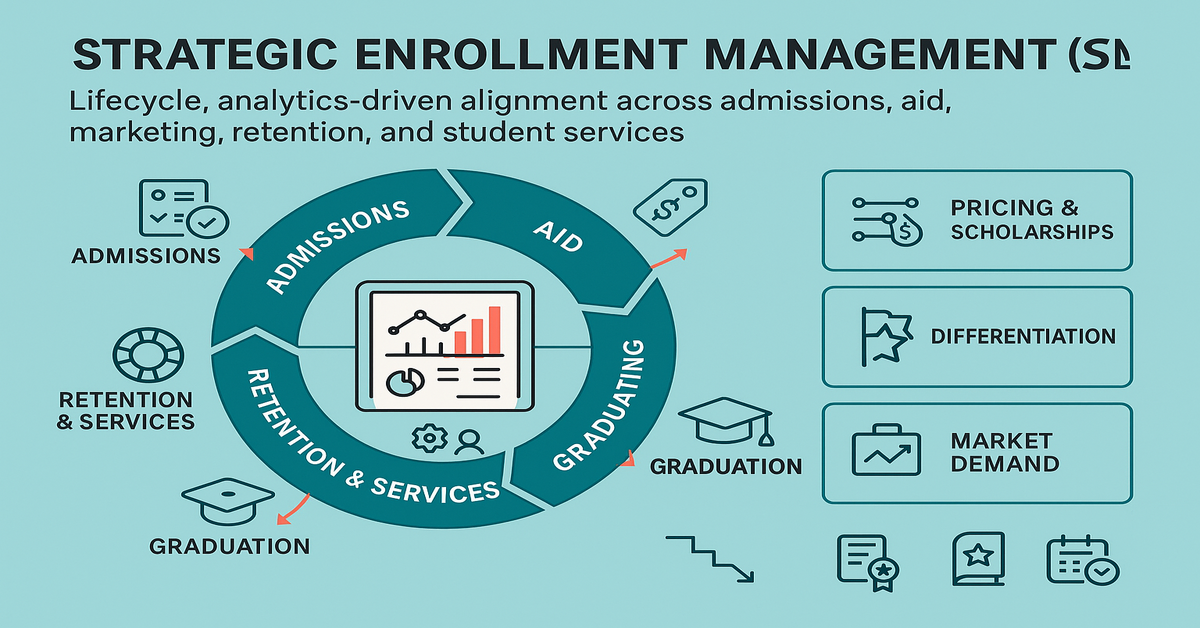
The article defines strategic enrollment management as a cross functional, analytics driven approach that aligns admissions, financial aid, marketing, retention, and student services to meet institutional goals. Effective SEM planning focuses on recruiting, enrolling, retaining, and graduating students in ways that support mission and fiscal sustainability. High impact plans emphasize structural alignment, data informed pricing and scholarships, clear differentiation, precision recruitment, integrated retention, academic offerings matched to market demand, and strong change management. As institutions face declining high school graduates, competition from alternative credentials, and growing expectations for flexibility and value, SEM must become more integrated and data driven across the full student lifecycle.
Read the article here (Author: evolllution.com)
Top Takeaways
- Adopt a lifecycle SEM model that unites admissions, aid, marketing, retention, and student services with shared analytics to align outcomes with mission and financial health.
- Drive results with structural alignment, data informed pricing and scholarships, clear market differentiation, precision recruitment, integrated retention design, and programs matched to labor market demand.
- Respond to market pressures, fewer traditional prospects, alternative credentials, and demand for flexibility, by deepening integration and using data to target, price, and support students more effectively.
Lifecycle SEM aligns admissions aid marketing and retention. Use data for pricing and precision recruitment. #HigherEd #Enrollment
Conclusion
The path forward is clear. Prove value with transparent, machine readable proof, align programs to real demand, and fund what performance data validates. Start by auditing program pages for schema, pricing, and outcomes. Then stand up a Share of Voice and AI visibility dashboard to spot gaps. Convene a cross functional SEM huddle to align pricing, recruitment, and retention, and greenlight one creative, trackable activation that builds affinity now. Measure, learn, and iterate. Let trust, relevance, and ROI guide the week ahead.