Prospects are not browsing endlessly anymore. They are choosing fast. New research shows most adults now shortlist three or fewer programs, and they lean on search engines and AI tools to get there. That means AI overviews, on-SERP answers, and trusted citations can make or break your visibility. If you are not present and verifiable in that moment, you are not in the consideration set. The race is decided before a click.
As a result, the center of gravity is shifting from traditional SEO to Generative Engine Optimization. Institutions win when their program and decision-support pages are machine-readable, evidence-backed, and consistent from a single source of truth. Structured data, plain-language answers, and strong E-E-A-T signals help AI systems cite you with confidence. Regular content audits surface the gaps where users search but do not find a clear answer. The mandate is simple. Be the most useful, citable page on the internet for each question you want to own.
Beyond search, the week’s insights push us to rethink how we build relationships and content. Not every social post should be a pitch. Platform-native stories, community updates, and real dialogue build durable trust. Meanwhile, smarter content starts with student interviews and on-site search data, then scales only what proves value. Quality beats volume, and discoverability beats duplication. With that lens, here are the takeaways to guide your next 90 days.
Key Takeaways
- Optimize for AI discovery, not just human skim. Use structured data, clear answers, and strong E-E-A-T so generative systems can understand and cite your pages.
- Run recurring, themed content audits to identify zero-click opportunities. Then build direct-answer pages that satisfy intent on SERP and in assistants.
- Shortlists are shrinking, so visibility at the exact moment of search decides winners. An AI citation can be the difference between making or missing the list.
- Start content with real student questions from interviews and site search. Then prioritize a few high-value assets you can measure and scale.
- Serve the audiences you already have on social with authentic, platform-native content and two-way conversation. Track engagement quality and sentiment over raw clicks.
Controversial Ideas
- Treat AI assistants as a primary audience segment. Design pages first for machine comprehension, then for human polish.
- Zero-click exposure can be more valuable than traffic for top-funnel outcomes. Impressions and citations may outrank sessions as success metrics.
- Every program page should read like a transparent product sheet. Pricing, outcomes, accreditation, and timelines are upfront, or you forfeit trust.
- A social calendar with fewer CTAs, and more community utility, can drive more long-term enrollments than daily promotional posts.
Win AI Discovery in Higher Ed
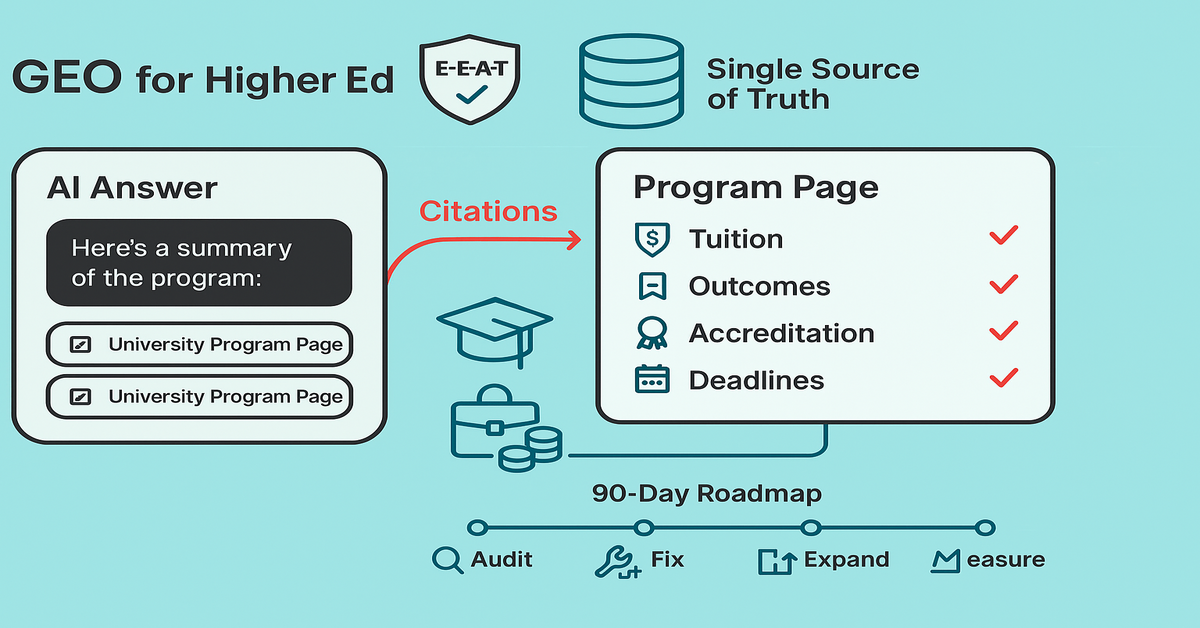
As students turn to ChatGPT, Perplexity, and AI Overviews for program advice, institutions must optimize to appear as trusted, citable sources in synthesized answers. Generative Engine Optimization extends SEO by prioritizing machine readability, structured data, transparent outcomes, and strong E-E-A-T across authoritative program pages and decision-support content.
Success requires consistent facts from a single source of truth, direct answers to student questions, credible third-party presence, and formats that connect programs to careers, costs, and outcomes. A 90-day roadmap guides teams from audit and prioritization to content and schema fixes, then expansion and measurement tied to AI mentions, citations, and enrollment impact. The goal is simple. Be the most useful, verifiable, and comparable resource for prospective students at the moment of AI-driven discovery.
Read the article here (Author: https://www.facebook.com/will.w.scott)
Top Takeaways
- Build authoritative, student-first program pages with clear answers, structured data, and evidence-backed details to be discoverable, understandable, and citable by AI systems.
- Create a single source of truth for tuition, outcomes, accreditation, and deadlines. Publish transparent methodologies and strengthen E-E-A-T and third-party profiles.
- Follow a 90-day plan. Audit AI answers, fix content and schema, add comparison and expert content, and measure AI mentions and citations tied to qualified demand and enrollments.
Be the source AI cites in 90 days with student first program pages clear answers structured data and one source of truth. #HigherEd #GenAI

Zero Click Wins with Content Audits
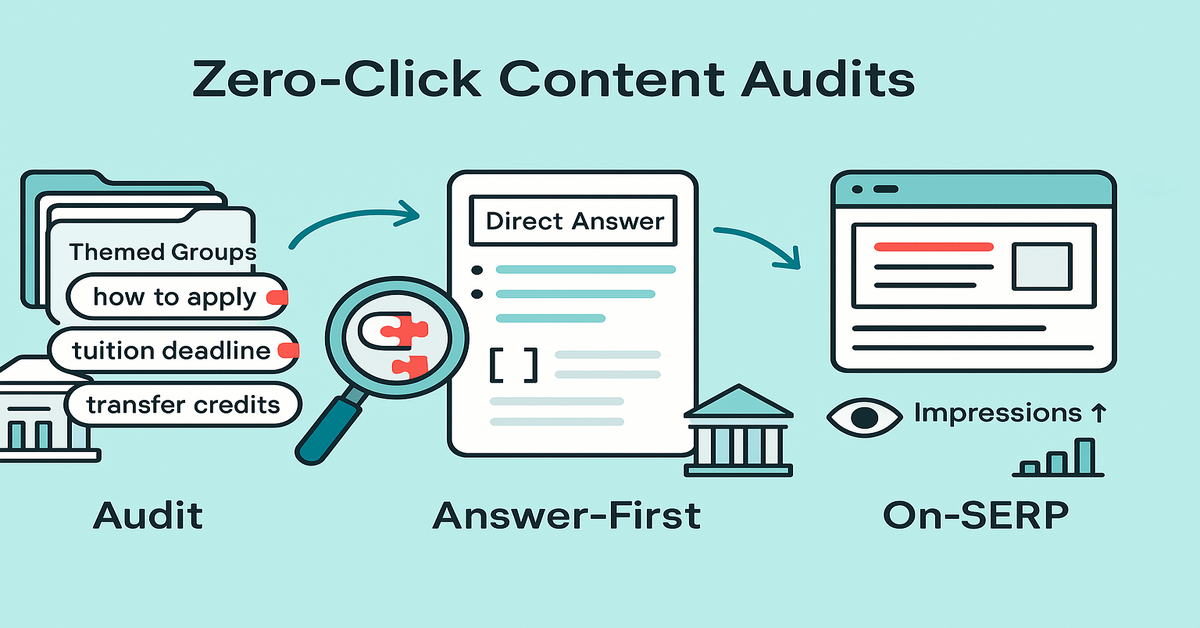
The article explains how regular, user-centric content audits fuel zero-click search visibility. By prioritizing themed page groups, extracting queries with impressions, and pinpointing content gaps, teams can craft clear, differentiated, answer-first pages optimized for SEO and AEO. Oakland Community College applies this approach to surface in search features where users get answers without clicking. The focus is on discoverability and intent satisfaction.
Read the article here (Author: Stamats Insights)
Top Takeaways
- Run recurring, themed content audits to find gaps where users search but no strong answers exist. Then create or refine content to fill those needs.
- Mine query impressions to map real user language and intent. Align page copy and structure to deliver concise, direct answers for SERP features and assistants.
- Measure success beyond clicks by tracking impressions and on-SERP presence, signaling improved discoverability in zero-click contexts.
Run themed content audits to win zero click results Mine query impressions fill gaps Track on SERP wins #SEO #AEO #ContentStrategy
AI Drives Smaller Program Shortlists
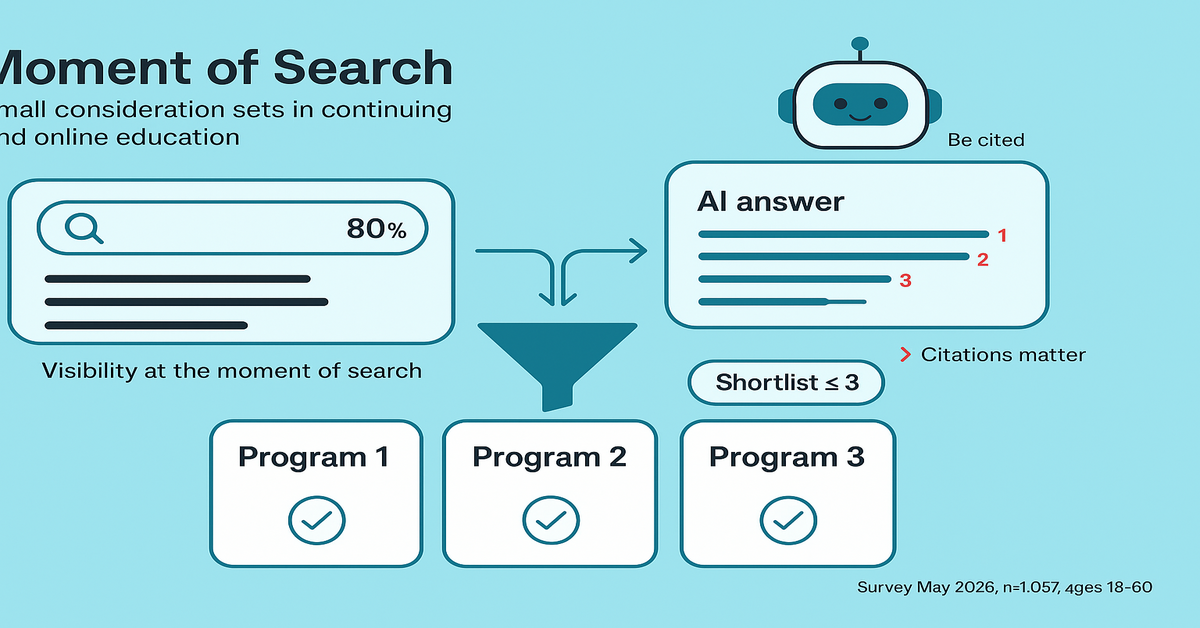
Updated research from UPCEA and Search Influence shows prospective students now consider three or fewer continuing and online education programs before applying. Search engines remain the primary starting point at 80 percent, and 54 percent also use AI tools. That makes AI-generated overviews and citations pivotal in shaping shortlists. With consideration sets this small, missing an AI citation can cost visibility. The May 2026 survey included 1,057 adults ages 18 to 60.
Read the article here (Author: UPCEA)
Top Takeaways
- Prospective students shortlist just three or fewer programs, making visibility at the moment of search critical.
- Search engines dominate discovery at 80 percent, and 54 percent also use AI tools. Appearing and being cited in AI answers can decide who makes the list.
- Institutions should optimize content for AI summaries and ensure accurate, attributable information to increase inclusion in shrinking consideration sets.
Prospective students pick 3 or fewer programs. 80 percent start on search and 54 percent use AI. Be cited or be skipped. #HigherEd #SEO #AI
Not Every Post Is A Pitch
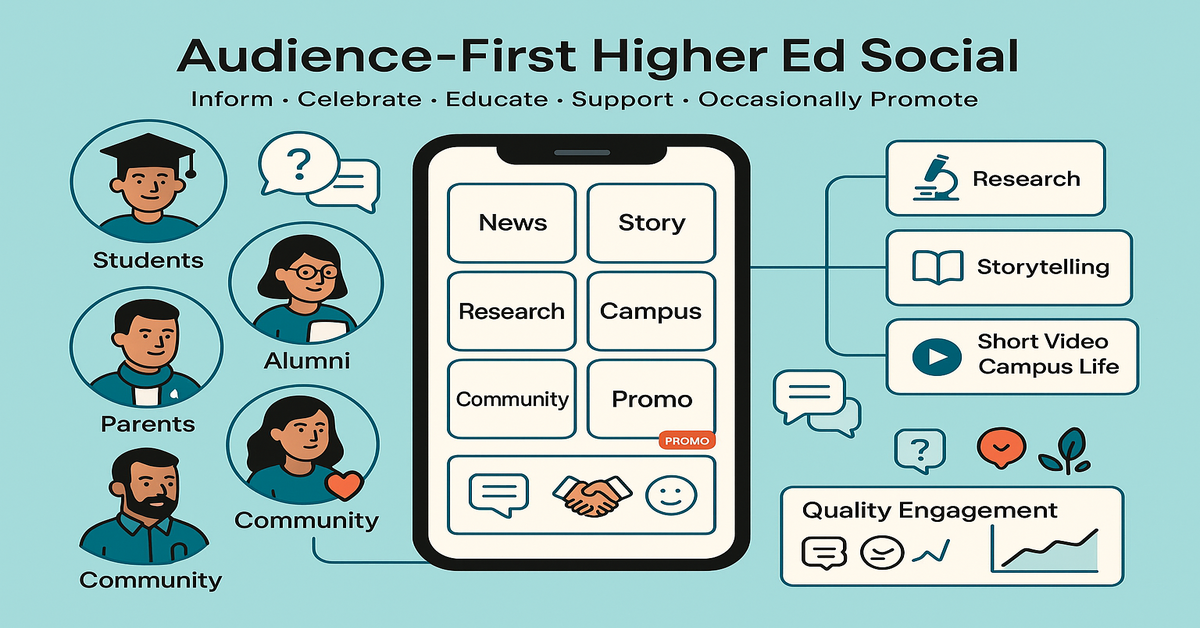
Many institutions treat every social post as a sales pitch, but effective higher ed social strategies serve the audiences already following them. Start by identifying current segments such as students, faculty, staff, alumni, parents, and community. Create purposeful content that informs, celebrates, educates, supports, and occasionally promotes. Think beyond the enrollment funnel. Relationship building matters even when it does not lead to an application. Use a varied, platform-native mix. For example, LinkedIn for research, Instagram for storytelling, and short video for campus life. Measure more than clicks by tracking engagement quality, sentiment, and community actions. Build trust through a consistent, authentic voice, and make space for dialogue. The result is a more useful, durable social presence.
Read the article here (Author: Jennifer Ravey)
Top Takeaways
- Start with the audiences you already have and tailor content to students, alumni, faculty, parents, and community so it feels relevant, not just promotional.
- Build a balanced, platform-native mix of news, stories, research, campus life, education, community, and occasional program promotion. Measure engagement quality, not just clicks and inquiries.
- Prioritize consistency, authenticity, and two-way conversation. Publish regularly, reflect real people and values, and invite questions, polls, and user-generated content to strengthen trust and long-term attention.
Stop pitching. Serve students alumni and community with native content and measure trust not clicks. Invite dialogue. #HigherEd #Engagement
Smarter Content Wins Enrollment
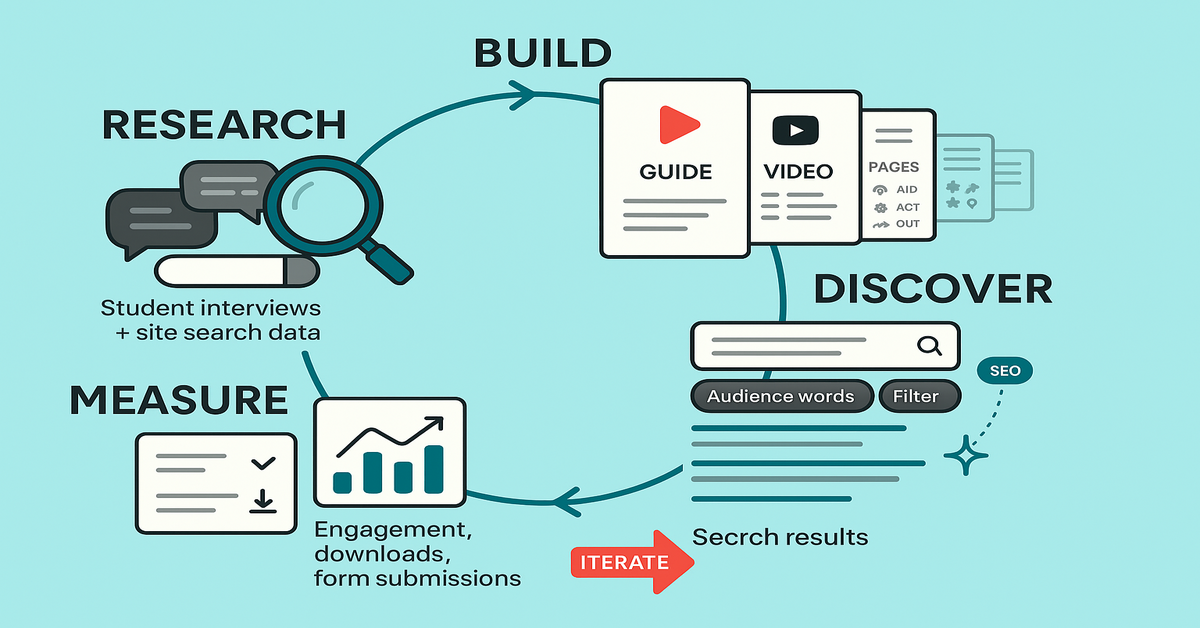
This article outlines a practical approach to higher ed content marketing. Start with audience research, then deliver focused, valuable resources. Make them discoverable, and measure for improvement. Interview recent students and mine website search data to surface real questions and gaps. Build helpful assets, such as guides, videos, and pages on admissions, financial aid, programs, student life, and outcomes, that signal relevance and intent. Prioritize quality over quantity by starting small, proving impact, and scaling what works. Use SEO, clear organization, and audience language to boost findability, including in AI search. Track engagement and conversions to refine content decisions.
Read the article here (Author: Stamats Insights)
Top Takeaways
- Combine student interviews with website search and behavioral data to identify content gaps and prioritize topics that matter most to prospects.
- Focus on quality over quantity. Create a few high-value resources that answer key questions in admissions, aid, academics, and outcomes, then scale proven formats.
- Make content easy to discover with SEO, clear site structure, and audience language. Measure impact via engagement, downloads, and form submissions to guide iteration.
Interview students and mine search data to fill content gaps. Start small with high value guides and track engagement. #HigherEd #SEO
Conclusion
Higher ed marketing is converging on a simple reality. The best-organized, most trustworthy answers win before anyone clicks. If you want to make the shortlist, claim your single source of truth, fix your schema and copy for AI readability, and fill zero-click gaps with direct, verifiable content. Pair that with audience-informed assets you can measure and expand, and a social presence built on consistency and conversation. Start a 90-day sprint. Audit, optimize, publish, and track AI citations and on-SERP presence. The institutions that move now will be the ones prospects find instantly.